Wet scrubbers explained: how they work, the main types and how to specify one
A wet scrubber cleans a contaminated air stream by passing it through a liquid that captures and neutralises the pollutants. It is the go-to technology for acid gases, ammonia, hydrogen sulphide and industrial odours, particularly where concentrations are high or fluctuate. This guide explains how a scrubbing tower works, the main types of gas scrubber, how a system is sized and where it is used across industry — from wastewater treatment works to chemical plants.
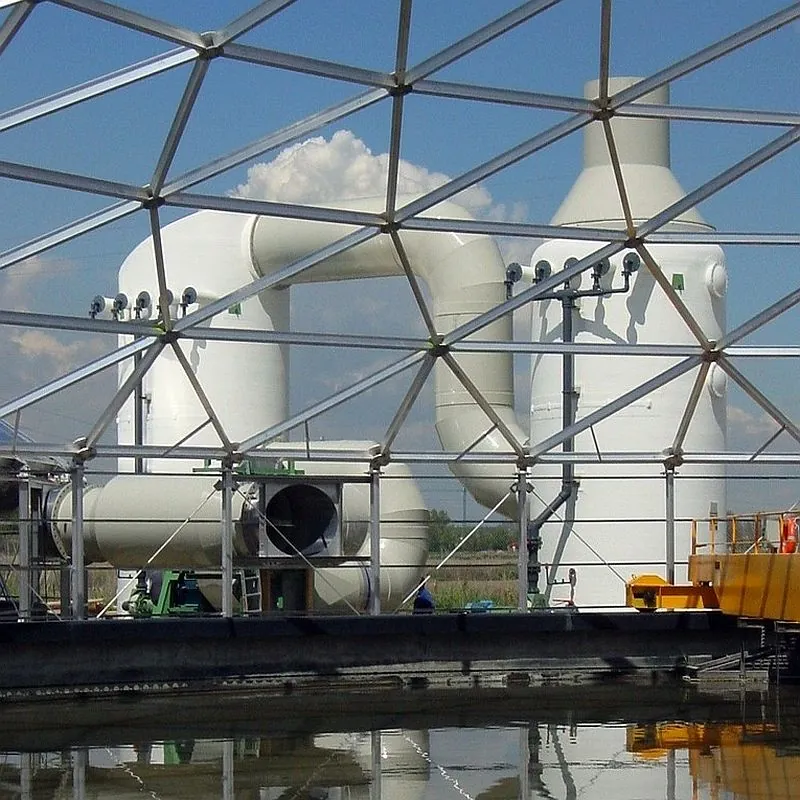
A wet scrubber (or gas scrubber) removes pollutants from an air stream by bringing it into close contact with a scrubbing liquid: water or an acidic, alkaline or oxidising solution.
Nitrogen compounds (NH₃, amines) are absorbed in an acidic medium; sulphur compounds (H₂S, mercaptans) and acid gases (HCl, HF, SO₂) in an alkaline or oxidising medium.
There are three main configurations: the packed tower, the venturi scrubber (for fine particles) and the cyclone separator, often combined in series.
A TECNIUM-CHEM scrubbing tower handles 100 to 100,000 m³/h with typical removal rates of 95–99% on the target contaminant.
The system is controlled by pH, ORP and conductivity and integrates with the site’s SCADA or PLC.
A wet scrubber cleans a contaminated air stream by passing it through a liquid that captures and neutralises the pollutants. It is the go-to technology for acid gases, ammonia, hydrogen sulphide and industrial odours, particularly where concentrations are high or fluctuate. This guide explains how a scrubbing tower works, the main types of gas scrubber, how a system is sized and where it is used across industry — from wastewater treatment works to chemical plants.
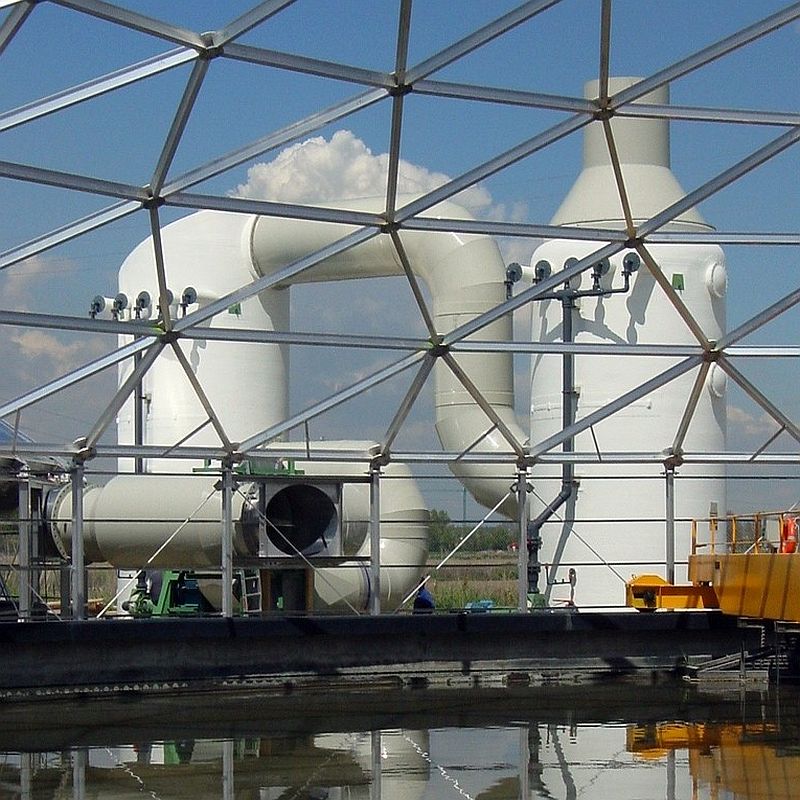
What is a wet scrubber and what is it used for?
A wet scrubber is an air pollution control system that removes contaminants from a gas stream through intimate contact with a liquid. The pollutant transfers from the gas into the liquid — it is absorbed — where it is either held or reacts with a chemical reagent that neutralises it. You will also see it described as a gas scrubber, a chemical scrubber or a packed tower scrubber; in this context they all refer to the same principle of “washing” the gas before it is released to atmosphere. More articles on the topic in Gas treatment.
The word “wet” distinguishes it from dry scrubbing, where a solid sorbent is used instead of a liquid. Wet scrubbing is one of several technologies TECNIUM combines to treat industrial emissions, alongside biofiltration, biotrickling, activated carbon adsorption, thermal oxidation, dry absorption, degassing and dedusting. Its great strength is versatility: the same type of equipment, with the right reagent, can handle acidic, alkaline or odorous gases, and it can be scaled to virtually any airflow. That is why wet scrubbers are such a familiar sight on wastewater treatment works, chemical plants and metal finishing lines.
The principle: absorption in an acidic, alkaline or oxidising medium
The chemistry of scrubbing depends on the nature of the contaminant. Many compounds found in industrial exhaust air can be absorbed or oxidised in an alkaline or acidic medium. Nitrogen compounds such as ammonia (NH₃) and amines are readily absorbed in an acidic medium. Sulphur compounds — hydrogen sulphide (H₂S), mercaptans and disulphides — are usually absorbed in an alkaline or oxidising medium. And some organic compounds, such as aldehydes, ketones and VOCs in general, can be broken down into CO₂ and water through energetic oxidation.
Which pollutants does a gas scrubber remove, and with which reagent?
Choosing the reagent is the central chemical decision in any scrubber design. The table summarises the most common combinations used in TECNIUM-CHEM chemical absorption systems:
| Contaminant | Scrubbing medium | Typical reagent |
| H₂S and mercaptans | Alkaline / oxidising | Caustic soda (NaOH), often with sodium hypochlorite (NaClO) |
| HCl, HF, SO₂ | Alkaline | Caustic soda (NaOH) |
| NH₃ and amines | Acidic | Sulphuric or hydrochloric acid |
| Oxidisable VOCs and organic odours | Oxidising | Sodium hypochlorite or hydrogen peroxide (H₂O₂), with pH and ORP control |
Chemical absorption is also applied to processes involving chlorine (Cl₂) and nitrogen oxides (NOx). The most widely used reagents — caustic soda, hypochlorite and sulphuric acid — are easy to source and handle, which keeps day-to-day operation straightforward.
Chemical or biological scrubbing: which to choose
Chemical absorption is the preferred option when pollutants arrive at high concentrations, in sharp and unpredictable peaks, when they are poorly biodegradable, or when emissions must stay below a very strict limit from the first minute of operation. Biological treatment, such as the TECNIUM BIO-TR biotrickling filter, excels under steady operation with biodegradable compounds at low concentrations, and without continuous reagent consumption. Many installations combine both technologies.
How does a wet scrubber work? Inside a scrubbing tower
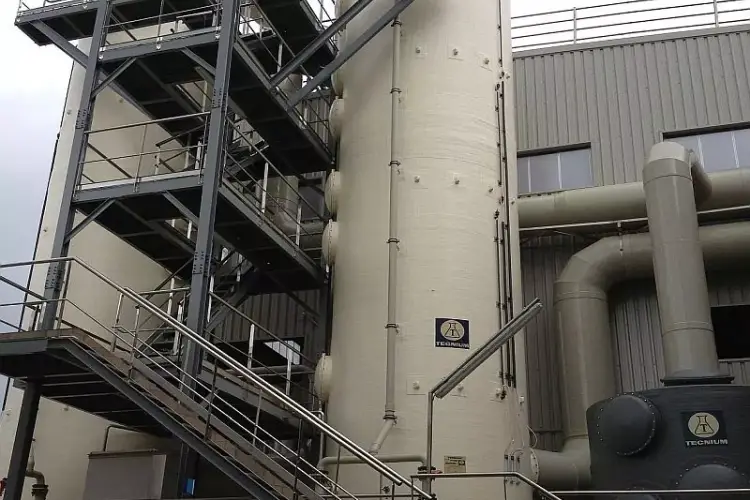
In a scrubber tower the gas and the liquid normally flow counter-current: the contaminated air enters at the bottom and rises, while the scrubbing liquid is distributed from the top and falls. Contact takes place across a transfer surface — the packing — designed to maximise the contact area between the two phases. Clean gas leaves at the top, and the liquid, now loaded with the pollutant, collects at the bottom to be recirculated. This is why the equipment is also known as an absorption tower or packed column. Gas velocity and liquid flow are balanced so that the packing stays evenly wetted without the tower flooding, which is what keeps performance stable across the whole operating range.
Key components: tower shell, packing, liquid distribution and mist eliminator
The main elements of a scrubbing tower are:
Tower shell: the column that houses the process, built from corrosion-resistant material.
Packing: random or structured packing that multiplies the contact surface between gas and liquid.
Distributors and spray nozzles: spread the liquid evenly across the full cross-section of the packing.
Mist eliminator: captures droplets carried by the gas before it leaves, so they do not reach the stack.
Sump, recirculation pump and fan: the sump collects the scrubbing liquor, the pump returns it to the distributors and the fan drives the gas through the system.
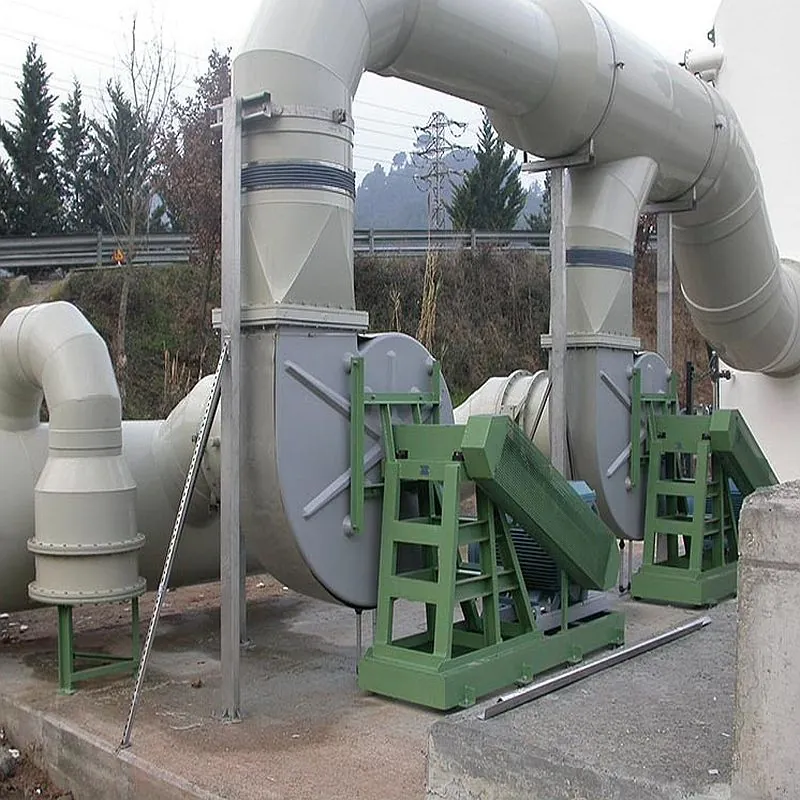
TECNIUM also supplies the ancillaries that complete the installation: fans, extraction hoods and enclosures, stacks, dampers, packing media, mist eliminators and suction ducting. The fan in particular has to withstand the gas before it has been cleaned, which is why it is built from the same kind of materials as our corrosion-resistant plastic fans.
Recirculation, bleed-off and pH and ORP control
A chemical scrubber runs automatically thanks to its instrumentation. A pH probe measures the recirculation liquor and controls reagent dosing to hold it at the setpoint. The oxidation-reduction potential (ORP) indicates how much oxidant is available when hypochlorite or peroxide is used. Conductivity governs the bleed-off: as the liquor builds up dissolved salts, part of it is purged and replaced with fresh water. Liquor and air flow rates, temperature and level are also monitored, and the whole system integrates with the client’s SCADA or PLC, keeping manual intervention to a minimum. Holding the pH at setpoint is not just about performance: a spent liquor lets the pollutant slip through, while overdosing drives up operating costs without improving the result.
Multi-stage scrubbers for mixed pollutants
When the gas contains pollutants that need incompatible scrubbing media, the usual answer is several stages in series. A typical example in wastewater treatment is an acid first stage to capture ammonia, followed by an alkaline stage with hypochlorite to remove hydrogen sulphide and mercaptans. This is the configuration TECNIUM used for a chemical odour control installation at a German wastewater treatment plant, with two scrubbing towers connected in series.
Types of wet scrubber: packed tower, venturi scrubber and cyclone
Not all scrubbers are the same. The TECNIUM-CHEM range is built around three configurations, selected according to the type of pollutant and the presence of particulates, and frequently combined on the same treatment line.
Packed tower scrubbers, vertical or horizontal
The packed tower scrubber is the most common configuration for soluble or reactive gases. TECNIUM scrubbing towers are vertical, with random or structured packing, and can incorporate several stages to deal with mixed pollutants. They cover airflows from 100 to 100,000 m³/h, with the shell made from GRP (glass-reinforced plastic, also known as FRP), polypropylene (PP) or HDPE. The TECNIUM catalogue also includes horizontal scrubbers for installations with limited headroom.
Venturi and multi-venturi scrubbers for fine particulates
A venturi scrubber accelerates the gas through a constriction — the throat — where the liquid is injected. The high velocity atomises the liquid into very fine droplets that capture particles, giving high efficiency on fine particulates and on gases with a heavy solids load. TECNIUM venturis have adjustable throats to cope with varying loads and are combined with cyclones downstream. One example is the venturi-cyclone dedusting system installed at a pig slurry treatment plant.
Cyclone separators
A cyclone separates particles and droplets by centrifugal force. In a scrubbing system it is installed in series with towers and venturis — upstream to remove solids, or downstream to collect entrained liquid — protecting the rest of the plant against corrosion from carryover.
| Packed tower | Venturi scrubber | Cyclone separator | |
| Main function | Gas absorption | Fine particulate capture | Separation of particles and droplets |
| When to use it | Soluble or reactive gases; mixtures, with several stages | Gases with a high solids content | In series, upstream or downstream of towers and venturis |
| TECNIUM data | 100–100,000 m³/h · GRP, PP or HDPE | Adjustable throats | Protection against carryover |
How to size and specify an industrial scrubber
Specifying an industrial scrubber starts with a clear picture of the gas to be treated. With its composition, airflow, temperature and the emission limit that has to be met, the manufacturer defines the configuration (number of stages, tower or venturi), the materials and the reagent. Chemical absorption has no practical airflow limit: it scales from a few cubic metres per hour to tens of thousands, with typical removal rates of 95–99% on the target contaminant.
Design inputs: airflow, pollutants, temperature and emission limit
To size a wet scrubber you will need: the gas flow rate, both maximum and normal; the pollutants present and their concentrations, including peaks; the temperature and humidity of the gas; whether particulates or mists are present; and the emission limit value set in the site’s environmental permit. Concentration peaks matter most, because they determine both the capacity of the tower and the response of the dosing system. Where data is uncertain, TECNIUM offers an advisory and testing service, with modular pilot plants for trials under real operating conditions.
Corrosion-resistant materials for the tower and internals
A scrubber is in constant contact with aggressive gases and liquids, so material selection is as important as process design. In TECNIUM-CHEM units the tower shell and pipework are made from GRP, PP or HDPE, depending on temperature and chemistry. The internals — spray nozzles, distributors and packing — are in PP or PVDF; gaskets in EPDM or Viton; and instrument probes in titanium or PVDF. Every material is selected case by case from the contaminant profile and the operating temperature. A common mistake is choosing the material for the main acid alone: oxidants such as hypochlorite, gas temperature and small amounts of solvents can attack plastics that resist that acid perfectly well. That is why it pays to give the manufacturer the full composition of both the gas and the scrubbing liquor, not just the target pollutant.
Reagents, consumption and operating costs
The running cost of a chemical scrubber depends mainly on reagent, water and energy consumption. For each application, TECNIUM evaluates the most effective solutions with three aims: to recover the pollutant as a saleable by-product where possible, to minimise energy and reagent consumption, and to strike the right balance between capital and operating costs according to the client’s priorities. Pressure drop across the tower and the power drawn by the recirculation pumps and fan are the main energy levers, as we explain in our article on energy efficiency in gas scrubbing.
Where are wet scrubbers used? Industrial applications
Gas scrubbing is found in any process that emits acidic, ammoniacal or odorous gases. These are the most common applications for TECNIUM-CHEM systems, and in most of them the scrubber is designed around the specific mix of pollutants on site rather than taken off the shelf.
Wastewater treatment works, composting and odour control
At wastewater treatment plants, scrubbers treat the air extracted from pumping wells, thickeners, preliminary treatment and sludge dewatering, as well as controlling H₂S and mercaptans in sewers and pumping stations. A well-designed H₂S scrubber is often what stands between a treatment works and odour complaints from neighbouring homes. Scrubbers are also used at composting sites and on anaerobic digesters.
Chemicals, pharmaceuticals, incineration and metal processing
In the chemical and pharmaceutical industry, scrubbers treat reactor vent gases, incineration and inerting gases, and processes involving HCl, HF, SO₂, Cl₂ or NOx. TECNIUM references include a chemical NOx absorption system at a chemical plant in Asia and a VOC absorption system for a pharmaceutical plant in France. Metal processing and surface treatment are another classic field, covered in our article on industrial gas scrubbing in the metallurgical industry.
Food processing
Abattoirs, animal by-product and rendering plants, fish processing plants and industrial frying and cooking lines all generate strong odours, often at fluctuating concentrations. Chemical absorption, on its own or combined with biological stages, keeps them under control and helps sites avoid complaints from the local community.
Frequently asked questions
A wet scrubber, also called a gas scrubber, is an air pollution control system that cleans a contaminated air stream by bringing it into contact with a scrubbing liquid — water or a chemical solution — that absorbs and neutralises the pollutants. It is used for acid gases, ammonia, hydrogen sulphide and industrial odours. The most common design is the packed tower, where gas and liquid flow counter-current.
A chemical scrubber removes acid gases such as HCl, HF and SO₂; sulphur compounds such as hydrogen sulphide and mercaptans; ammonia and amines; and some oxidisable VOCs and organic odours. It is also used on processes involving chlorine and nitrogen oxides. Venturi scrubbers also capture fine particulates. The scrubbing reagent is chosen to suit the pollutant: acidic, alkaline or oxidising.
A packed tower passes the gas through packing wetted by the scrubbing liquid and is the right choice for absorbing soluble or reactive gases. A venturi scrubber accelerates the gas through a throat where the liquid is atomised, making it more effective at capturing fine particulates in gases with a high solids load. The two are often combined, with cyclone separators in series.
For acid gases (H₂S, HCl, HF, SO₂), caustic soda is used, often combined with sodium hypochlorite when mercaptans also need to be oxidised. For ammonia and amines, sulphuric or hydrochloric acid is used. For oxidisable VOCs and organic odours, oxidants such as hypochlorite or hydrogen peroxide are applied, with the pH and ORP closely controlled.
In TECNIUM-CHEM chemical absorption systems, typical removal rates are 95–99% on the target contaminant. Actual performance depends on the design (packing, number of stages, contact time), the reagent and correct control of pH and ORP. For mixed pollutants, several stages are installed in series so that each one works under the right chemical conditions.
A chemical scrubber is the better choice for high concentrations, sharp peaks, poorly biodegradable compounds or very strict emission limits from start-up. A biotrickling filter performs best with steady loads, biodegradable compounds and low concentrations, and does not consume reagents continuously. Many installations combine both technologies to get the advantages of each.
Need to treat acid gases or odours? Tell us your airflow, the pollutants and their concentrations, and we will propose the right scrubber configuration and reagents. Contact TECNIUM
How can we help you?
Tell us about your application and we will advise you the most optimal solution to solve your needs of gas treatment, odor control and storage and pumping of corrosive fluids.