
Thermal Oxidation: TECNIUM-RTO
Thermal destruction of polluting emissions through incineration in furnaces operating at temperatures above 700 °C in the case of regenerative thermal oxidation, or close to 400 °C when catalysts are used.
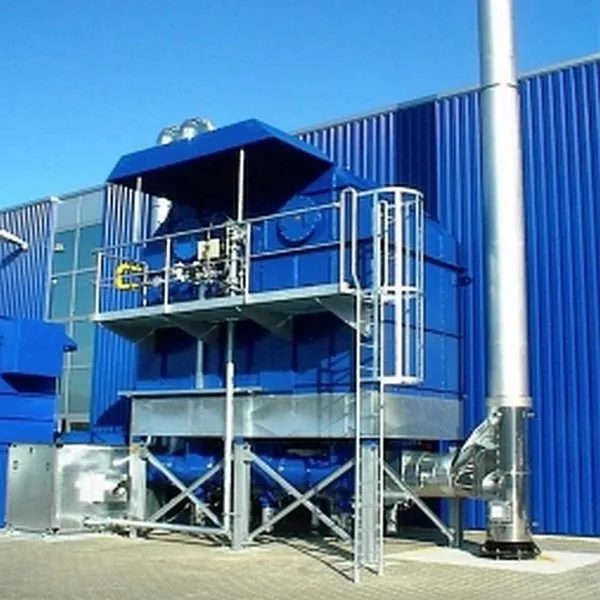
High-temperature oxidation to destroy VOCs and complex organic compounds
The process consists of the oxidation through incineration of polluting emissions in furnaces operating at temperatures above 700 °C in the case of regenerative thermal oxidation, or close to 400 °C when catalysts are used.
Inside the furnace, volatile organic compounds are broken down into CO₂ and water vapour, achieving destruction efficiencies greater than 99% for a broad spectrum of VOCs and complex organic compounds.
TECNIUM designs the installation tailored to the customer’s process, integrating heat exchangers, energy recovery systems, switching valves and automatic control to minimise the consumption of auxiliary fuel.
Key advantages of thermal oxidation
A clean technology, fully automatable and economical to operate for VOCs and complex organic compounds.
Three technologies for three different scenarios
TECNIUM offers all three thermal oxidation variants. Selection depends on flow rate, VOC concentration and the balance between CAPEX and OPEX.
Recuperative Thermal Oxidation
Combustion chamber with plate or tube heat exchanger to preheat the incoming air with the outgoing gases.
Regenerative Thermal Oxidation
Ceramic beds that alternately store and release heat, reaching very high thermal efficiencies and self-sustaining operation in many applications.
Catalytic Thermal Oxidation
Catalytic bed that reduces the combustion temperature close to 400 °C, lowering energy consumption and allowing more compact equipment.
Sectors where TECNIUM-RTO is a reference
Thermal oxidation is the standard solution for emissions with a high VOC content from printing, coating and graphic arts processes.
Printing and graphic arts
- Paper and fabric printing
- Graphic arts in general
- Heatset, flexography and gravure printing
- Labelling and packaging
Inks, paints and coatings
- Ink and paint manufacturing
- Application of special coatings
- Surface treatment
- Automotive paint lines
Electronics and other processes
- Specific treatment of electronic components
- Solvent cleaning in pharmaceutical industry
- Chemical processes with VOC emissions
- Waste gas treatment plants
FAQs on TECNIUM-RTO thermal oxidation
The most common queries on thermal oxidation types, energy consumption and differences with alternative technologies.
What is the difference between RTO, recuperative and catalytic?
Regenerative thermal oxidation (RTO) uses ceramic beds that alternately heat and cool, achieving thermal efficiencies of 95-97% and often self-sustaining operation. The recuperative variant uses a conventional heat exchanger with efficiencies of 60-75%. The catalytic variant lowers the oxidation temperature to ~400 °C thanks to a catalytic bed, saving fuel but requiring gas free of catalytic poisons (S, Cl, P, metals). Selection depends on flow rate, VOC concentration and contaminant mixture.
What VOC destruction efficiency is achieved?
Well-designed TECNIUM-RTO installations achieve destruction efficiencies above 99% for a broad spectrum of VOCs. Efficiency depends on residence time (typically 0.75-1 second), combustion temperature and turbulence in the chamber. Compliance with the legal emission limit (mg/Nm³) is demonstrated through FID measurements at the outlet.
When should thermal oxidation be preferred over adsorption or absorption?
Thermal oxidation is the appropriate option when VOC concentration is high (typically > 1 g/Nm³), when there is a variety of complex non-biodegradable organic compounds, or when the goal is to destroy the contaminant rather than simply transferring it between phases. For low concentrations and small flow rates, activated carbon adsorption (TECNIUM-CARB) or chemical absorption (TECNIUM-CHEM) tend to be more economical.
How much fuel does an RTO consume?
A well-designed RTO with thermal efficiency of 95-97% usually operates self-sufficiently (without natural gas input) when VOC concentration exceeds 1.5-2 g/Nm³, since combustion of the compounds themselves supplies the required energy. Below that concentration, natural gas is added as auxiliary fuel; the higher the RTO’s thermal efficiency, the lower the consumption.
Can the energy of combustion be recovered?
Yes. In addition to the internal recovery of the furnace itself, TECNIUM-RTO units accept additional downstream exchangers to preheat water, generate steam or heat customer processes. In installations with high concentrations and steady flow rates, external recovery can significantly reduce the overall energy cost of the process.
What materials are used and what does maintenance involve?
The combustion chamber is built in refractory stainless steel, the ceramic beds in structured alumina or cordierite, and the switching valves are designed for millions of cycles. Typical maintenance includes annual inspection of valves and gaskets, periodic cleaning of the ceramic bed to prevent inorganic scaling, and replacement of the catalyst every 3-5 years in catalytic RTOs.
Send us your details and we will advise you
We will help you select the most suitable TECNIUM-RTO variant and size the equipment from your flow rate, VOC concentration and emission targets.
- Emission characterisation and thermal balance
- Selection between RTO, recuperative or catalytic
- Turnkey equipment with automatic control
- Start-up and global aftersales support
Request information
Complete the form and our technical team will get in touch with you.
Explore all our solutions
Discover the full range of TECNIUM products for the treatment of corrosive fluids and polluting gases.