Biotrickling filters: how they work and when to use them
Within the field of biological gas treatment, biotrickling filters — also known as percolating biofilters — have established themselves as the most efficient solution for water-soluble contaminants at medium-to-high concentrations. Unlike classic fixed-bed biofilters, they incorporate a recirculated aqueous solution that allows precise control of pH, temperature and nutrients, dramatically widening the range of possible applications.
- What a biotrickling filter is and how it differs from a classic fixed-bed biofilter.
- How it works: inert support, microbial biofilm and recirculated aqueous solution with pH control.
- When to choose it: H₂S, mercaptans and soluble VOCs at medium and high concentrations.
- Advantages over classic biofilters, chemical scrubbers, thermal oxidation and activated carbon.
- Design criteria, maintenance and Tecnium experience in WWTPs, slurry treatment, biogas and MBT plants.
Within the field of biological gas treatment, biotrickling filters — also known as percolating biofilters — have established themselves as the most efficient solution for water-soluble contaminants at medium-to-high concentrations. Unlike classic fixed-bed biofilters, they incorporate a recirculated aqueous solution that allows precise control of pH, temperature and nutrients, dramatically widening the range of possible applications.
Their versatility makes them the preferred technology to treat H₂S in WWTPs and biogas, ammonia in slurry and fertilisers, and mercaptans in chemical and pulp & paper industries. In sectors subject to increasingly demanding regulation — Directive 2010/75/EU (IED), sector BREFs, national environmental permits and the UK Environmental Permitting Regulations — biotrickling filters deliver 95-99 % removal efficiencies at operating costs far lower than a conventional chemical scrubber.
Tecnium, Spanish manufacturer of corrosion-resistant fluid-handling and gas-treatment equipment since 1957, designs, manufactures and installs turnkey biotrickling filters in FRP, PP, PVDF and PVC, tailored to each sector and flow rate. In this guide we look at what exactly a biotrickling filter is, how it works, when to choose it over other alternatives and how to size it correctly.
What a biotrickling filter is and how it works
The biotrickling filter is a hybrid biological reactor that combines the absorption of contaminants in a liquid phase with their microbial degradation. It is the natural evolution of the classic biofilter, designed to overcome its limitations in pH control, support service life and treatment capacity.
Definition and biological principle of the biotrickling filter
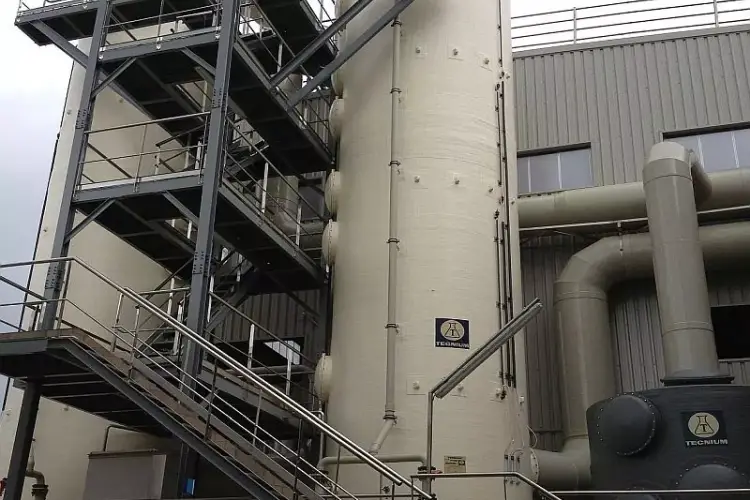
A biotrickling filter (BTF) is a column or tower filled with an inert support material of high specific surface area — plastic rings, structured packings or ceramic media — on which an active microbial biofilm develops. Two streams flow simultaneously through the bed: the contaminated gas and an aqueous solution recirculated continuously from the top of the column.
The mechanism operates in three stages: first, the gaseous contaminant dissolves into the aqueous phase that wets the support; then it transfers to the microbial biofilm coating the packing particles; finally, it is metabolised by the microorganisms as a source of carbon, energy or electron donors. End products are water, CO₂, new biomass and soluble inorganic salts (sulphates when treating H₂S, nitrates when treating NH₃) that leave the system with the recirculation liquid purge.
Active control of the trickling liquid keeps the microorganisms under optimal conditions: stable pH, controlled temperature, continuous nutrient supply (N, P, trace elements) and removal of inhibitory metabolites. This is the fundamental difference with the classic biofilter, whose organic bed relies solely on ambient humidity.
Main components of a biotrickling filter system
An industrial biotrickling filter installation is made up of several components that work together. Each component performs a specific function and must be sized correctly to guarantee overall performance:
- Column or containment tower: vertical cylindrical structure manufactured by Tecnium in FRP, PP or PVDF depending on the aggressiveness of the contaminant and the operating pH. Typical diameters of 1 to 4 metres and bed heights of 2 to 6 metres.
- Support material (packing): random rings (Pall, Raschig) and structured packings. Inert, highly porous and with a very long service life.
- Liquid recirculation system: corrosion-resistant pumps — typically from the Tecnium PP or PVDF range — that lift the aqueous solution from the bottom tank to the top spray distributors. Typical flow rates of 0.5 to 5 m³/m²·h.
- Distribution and spraying: nozzles or spray manifolds that distribute the liquid uniformly across the bed to ensure complete wetting of the support.
- Reagent and nutrient dosing: dosing pumps for automatic pH control, nutrient top-up and make-up water.
- Instrumentation and control: pH, temperature, gas flow and bed pressure-drop sensors, plus inlet and outlet contaminant analysers in advanced installations.
Key differences between classic biofilters and biotrickling filters
Understanding the differences between the two main biofiltration families is essential to choose the right technology. The table below summarises the key technical aspects:
| Feature | Fixed-bed biofilter | Biotrickling filter |
|---|---|---|
| Support material | Organic (peat, compost, heather) | Inert (rings, ceramics) |
| Liquid phase | Bed humidification only | Recirculated aqueous solution |
| pH control | Limited | Precise, continuous |
| Support service life | 3-5 years | 10+ years |
| Optimal concentration | Low | Medium-high |
| Typical EBRT | 30-60 s | 8-30 s |
| Plant footprint | Large (low height) | Compact (taller) |
| Ideal contaminants | Diluted VOCs and complex odours | H₂S, mercaptans, soluble VOCs |
In summary: the classic biofilter is the most economical and robust option for large flow rates with low concentrations and diluted contaminants; the biotrickling filter is superior when there are medium-to-high concentrations, soluble contaminants or the need for fine process control.
When to use a biotrickling filter
The biotrickling filter is not the answer to every gas treatment problem, but it is the best option available when certain process conditions are met. Choosing it correctly means knowing the ideal contaminants, comparing with alternatives and considering sector experience.
Ideal contaminants for a biotrickling filter
Biotrickling filters shine with contaminants that are water-soluble and biodegradable. The main groups are:
- Hydrogen sulphide (H₂S): the flagship contaminant of biotrickling. Highly soluble, present in WWTPs, anaerobic digestion, biogas, sludge plants and slurry treatment.
- Mercaptans and reduced sulphur compounds (DMS, DMDS): low concentrations but very odorous, typical of pulp & paper mills (Kraft process) and wastewater treatment plants.
- Soluble VOCs: alcohols (ethanol, methanol, isopropanol), ketones, light aldehydes and esters. Any compound with a high Henry’s constant is a good candidate.
- Acidic gases: SO₂, HCl and other soluble inorganic gases, taking advantage of the system’s precise pH control.
Biotrickling is not the best option for highly hydrophobic VOCs such as BTEX aromatics (which do not dissolve sufficiently in the aqueous phase), nor for very large flow rates at very diluted concentrations (where the classic biofilter or activated carbon are more economical).
Advantages of biotrickling filters over other technologies
Choosing a biotrickling filter means comparing it with the alternatives on the market. Its four main strengths against competing technologies are:
- Versus classic biofilter: higher efficiency with soluble contaminants and high concentrations, precise pH and temperature control, far longer support service life (10+ years vs 3-5) and a more compact footprint.
- Versus chemical scrubber: it does not consume costly reagents nor produce hazardous waste; it only requires water, basic nutrients and a small dose of alkali or acid for pH control. Operating costs can be up to five times lower.
- Versus thermal oxidation: minimal energy consumption, no NOx or CO₂ from combustion and no auxiliary fuel required.
- Versus activated carbon: continuous treatment without media saturation, no hazardous waste (saturated carbon must be managed as special waste) and no shutdowns for filter replacement.
Industrial sectors where Tecnium installs biotrickling filters
The Tecnium range of gas treatment technologies, including its TecniumBio biofiltration and biotrickling line, has been installed in sectors with real challenges from odorous emissions and soluble compounds. Some representative examples from the Tecnium track record:
- WWTPs and wastewater plants: H₂S removal in anaerobic digestion, pumping stations, sludge dewatering and thickeners. This is the sector with the most historic biotrickling references.
- Slurry treatment and intensive livestock farms: control of NH₃ and H₂S odours before atmospheric emission, complying with national and regional odour regulations.
- Biogas and biomethane: biological desulphurisation of biogas (H₂S removal) prior to its valorisation in CHP units or upgrading to biomethane.
- MSW and composting: treatment of air captured in composting tunnels, reception halls and mechanical-biological treatment (MBT) areas.
- Chemical and pharmaceutical industry: treatment of soluble VOCs, mercaptans and sulphur-bearing gases from industrial processes.
- Pulp & paper (Kraft process): removal of low-concentration but highly odorous mercaptans and reduced sulphur compounds.
Design, maintenance and frequently asked questions
A biotrickling filter that is poorly sized or poorly operated loses efficiency quickly: the biofilm degrades, pH drifts and odours return. A rigorous design and adequate maintenance are as important as the technology itself.
Key design and sizing criteria
Sizing a biotrickling filter correctly requires evaluating several process parameters together. The most relevant technical criteria are:
- Gas flow rate to treat: Tecnium sizes towers from 500 to 35,000 Nm³/h in a single unit, with parallel modular configurations for higher flow rates.
- Empty bed residence time (EBRT): typical values between 8 and 30 seconds — significantly lower than in classic biofilters thanks to the greater gas-liquid transfer efficiency.
- Volumetric contaminant load: up to 100-200 g H₂S/m³·h, compared with the 10-30 g/m³·h of a classic biofilter.
- Liquid recirculation flow: 0.5 to 5 m³/m² of section·h, adjusted according to contaminant and load.
- pH control: for H₂S, operation in acidophilic phase (pH 1-3, Thiobacillus bacteria); for NH₃, alkaline phase (pH 6-8, nitrifying bacteria). For combined treatment, two stages in series are used.
- Construction materials: FRP, PP, PVDF and PVC for tower and accessories, selected according to the aggressiveness of gas and recirculation liquid.
Maintenance, operation and service life
A well-designed and maintained biotrickling filter offers a service life of more than 20 years for the containment structure (FRP tower, piping, tank), and the inert support comfortably exceeds 10 years of operation. The system’s consumables are make-up water, nutrients (N, P and trace elements) and pH-control reagents.
Standard maintenance operations include daily monitoring of pH, recirculation flow rate and temperature, weekly inspection of pumps and dosing units, periodic cleaning of the irrigation system, analysis of the liquid effluent (sulphates, nitrates) and nutrient top-up based on process mass balances.
The key operational advantage over the classic biofilter is that the biotrickling filter does not require periodic bed replacement: the inert support is cleaned and reactivated rather than replaced, eliminating one of the largest recurring costs of conventional biofiltration.
Frequently asked questions about biotrickling filters
The classic biofilter uses an organic support bed (peat, compost, heather) and only requires humidification; the biotrickling filter uses an inert support (rings, ceramics) over which an aqueous solution with nutrients and pH control is continuously recirculated. The biotrickling filter can handle higher concentrations, offers much tighter process control and its support lasts more than 10 years compared with 3-5 for the classic biofilter. The classic biofilter, on the other hand, is more economical for high flow rates with diluted contaminants.
Cost depends on flow rate, contaminants and construction materials. As an order of magnitude, a standard industrial installation ranges from €40,000 to several hundred thousand euros. The total cost of ownership (TCO) of a biotrickling filter is up to five times lower than an equivalent chemical scrubber, with typical paybacks of 3 to 5 years compared with alternatives such as activated carbon or thermal oxidation.
The best candidates are water-soluble and biodegradable contaminants: H₂S, mercaptans, DMS/DMDS, soluble VOCs (alcohols, ketones, aldehydes) and acidic gases such as SO₂ or HCl. It is not suitable for hydrophobic VOCs such as BTEX (low solubility in water) or for very large flow rates at very diluted concentrations, where the classic biofilter is more economical.
Yes. Biological desulphurisation of biogas via biotrickling filter is one of the fastest-growing applications in the sector. It removes H₂S from biogas prior to its valorisation in CHP units or upgrading to grid-injectable biomethane. Compared with chemical technologies, it offers far lower operating costs and generates no hazardous waste. Tecnium designs specific systems for this rapidly expanding market.
The tower and containment structure in FRP comfortably exceed 20-25 years of service life. The inert support (packing) has a service life of over 10 years, far longer than the organic bed of the classic biofilter, which must be replaced every 3-5 years. Consumables (nutrients, pH reagents, water) are replenished continuously without shutting down the plant.
Well-designed and well-operated biotrickling filters achieve removal efficiencies of 95-99 % for H₂S, NH₃ and mercaptans, meeting and often exceeding the limit values set by Directive 2010/75/EU (IED), the sector BREFs and national regulators such as DEFRA and the Environment Agency in the UK. Combining biotrickling with a classic biofilter or a chemical scrubber in a multi-stage configuration reaches 99.9 % for particularly demanding applications.
If you need a biotrickling filter solution for odour control or the treatment of soluble gases at your industrial site, the Tecnium technical team can help you define the optimal system: flow rate, support type, pH control, corrosion-resistant materials and sizing in line with European BAT. Request a no-obligation quotation using the form below and receive personalised advice from a manufacturer with more than 70 years of experience in industrial gas treatment.
How can we help you?
Tell us about your application and we will advise you the most optimal solution to solve your needs of gas treatment, odor control and storage and pumping of corrosive fluids.