Industrial centrifugal fans for corrosive fumes: a selection guide
An industrial centrifugal fan draws in and moves gases while overcoming the resistance of ductwork, hoods, filters and scrubbing towers. When the fumes are acidic, oxidising or otherwise corrosive, steel is no longer an option: the casing and impeller need to be made from engineering plastics. This guide explains how to choose one through four decisions — material, airflow and pressure, drive type and shaft seal — using data from TECNIUM’s HS/MS and MP/MM fan series.
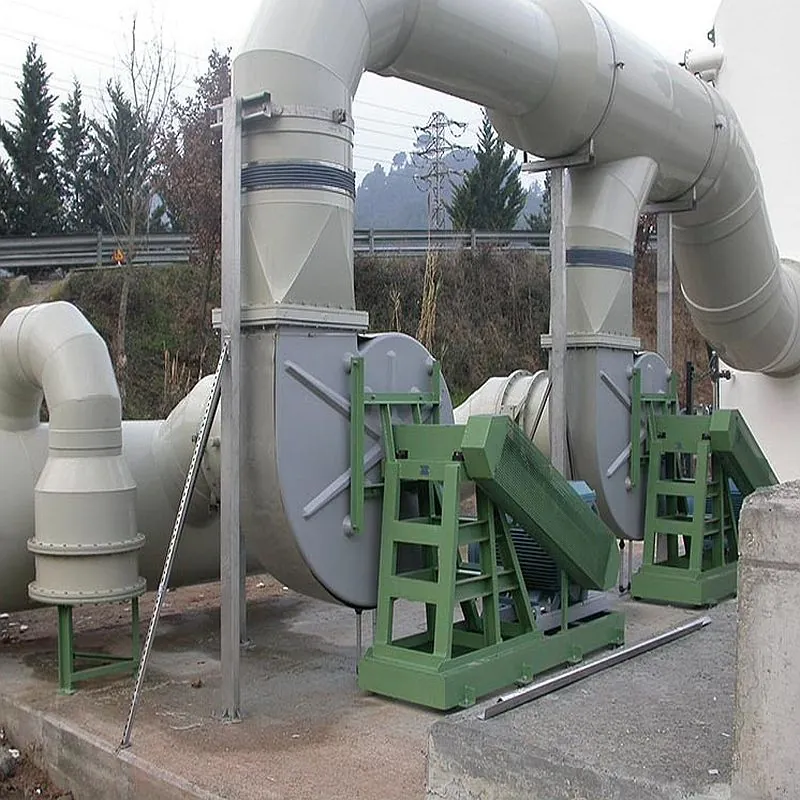
An industrial centrifugal fan is the right choice when the system has resistance to overcome: long ductwork, capture hoods, filters or scrubbing towers.
For corrosive fumes, every part in contact with the gas is made from plastic — PP, PVC, PVDF or GRP — chosen to suit the gas and its temperature.
Sizing starts from airflow and total pressure; static pressure is total pressure minus velocity pressure, corrected for temperature, altitude and gas density.
The HS/MS series (direct drive) reaches 40,000 m³/h and 4,500 Pa; the MP/MM series (belt drive) reaches 120,000 m³/h and 7,000 Pa.
The shaft seal is chosen according to how hazardous the gas is: a mechanical seal is the option for toxic or dangerous gases.
An industrial centrifugal fan draws in and moves gases while overcoming the resistance of ductwork, hoods, filters and scrubbing towers. When the fumes are acidic, oxidising or otherwise corrosive, steel is no longer an option: the casing and impeller need to be made from engineering plastics. This guide explains how to choose one through four decisions — material, airflow and pressure, drive type and shaft seal — using data from TECNIUM’s HS/MS and MP/MM fan series.
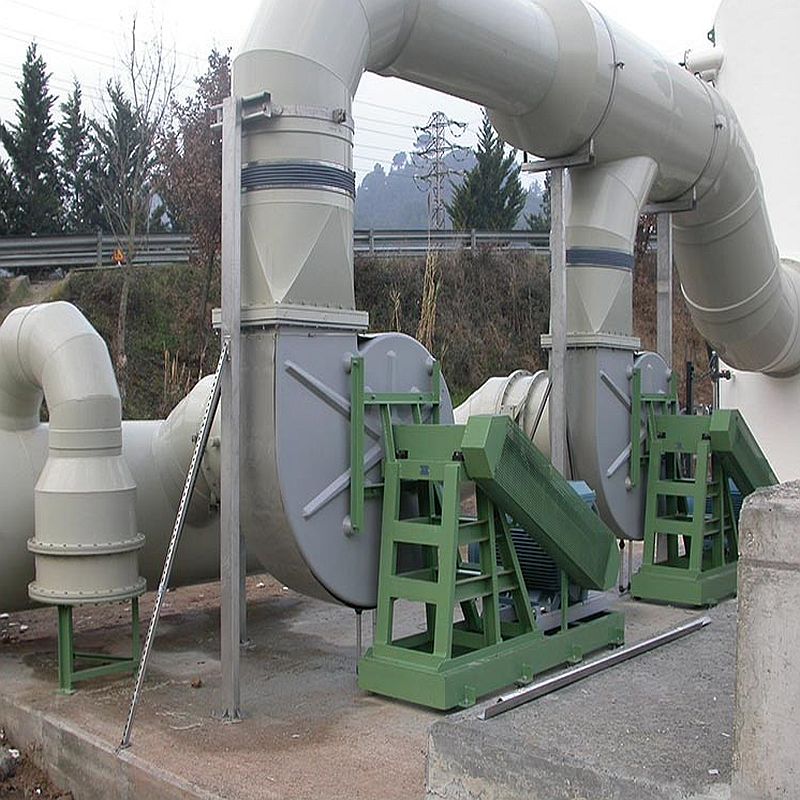
What is an industrial centrifugal fan and when should it be plastic?
An industrial centrifugal fan draws gas into the centre of a rotating impeller and discharges it at right angles, converting the velocity imparted by the impeller into pressure. That ability to generate pressure is what makes it essential in process ventilation and fume extraction systems: every metre of duct, every capture hood and every item of air pollution control equipment adds resistance, and the fan has to overcome it to maintain the design airflow at every extraction point. More articles on the topic in Gas treatment and Pumps.
If the air also carries acid vapours, pickling mists, chlorine or solvents, the fan stops being an ancillary item and becomes a critical component: it is the machine in permanent contact with the most aggressive gas on site. In the UK, many of these fans form part of a local exhaust ventilation (LEV) system, so their performance also matters for protecting workers’ health.
How it works: impeller, scroll casing and inlet
Gas enters through the inlet cover, in line with the shaft. The impeller, mounted on a hub that transmits torque from the motor, spins and accelerates the gas towards its outer edge. The scroll casing — the volute — collects that flow, slows it down and converts its velocity into pressure before delivering it through the outlet. The TECNIUM catalogue completes the assembly with shaft, bearings, casing gasket and a drain connection at the bottom of the casing, which is needed to remove the condensate that forms when handling wet gases.
In TECNIUM fans, torque is transmitted to the impeller through a metal key and a large-surface steel hub, and the impeller is statically and dynamically balanced to minimise vibration.
Centrifugal fan vs axial fan: which to choose
The centrifugal fan vs axial fan question is settled by looking at the installation. An axial fan moves air along the line of its shaft and is efficient at shifting large volumes against very little resistance, as in general ventilation of a building. As soon as the air has to pass through a duct network, a scrubber, a biofilter or an activated carbon filter, the pressure required rises and a centrifugal fan is the right solution.
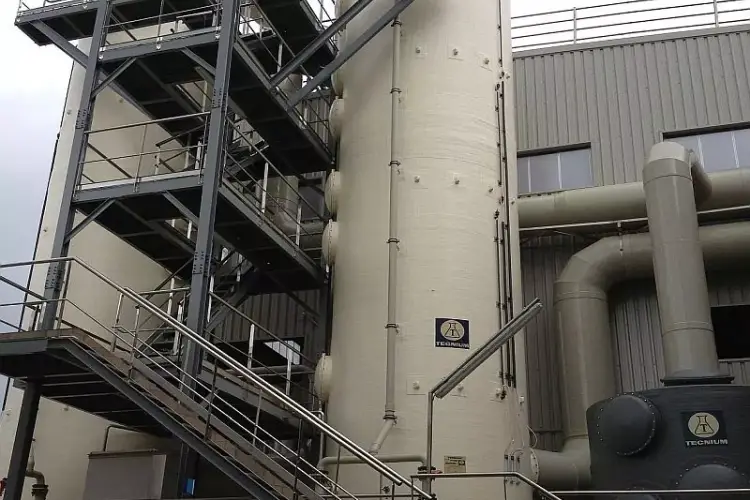
This is why air pollution control systems are almost always designed with centrifugal fans: an absorption tower such as the TECNIUM-CHEM chemical scrubber creates a pressure drop that an axial fan cannot overcome reliably.
Why a steel fan fails on acid fumes
A carbon steel or galvanised fan handling hydrochloric, sulphuric or hydrofluoric acid vapours corrodes from the inside, where nobody can see it. The impeller loses material first, goes out of balance and transmits vibration to the bearings; then the casing starts to perforate and gas leaks out. Stainless steels improve resistance to some media, but not to chlorides or many oxidising agents, and they add considerable cost without solving the underlying problem.
The alternative is to build everything that touches the gas from plastic. That is exactly what TECNIUM does: in its fans, all parts in contact with the gas are made from a plastic material selected for each application, with special metals used only for high-speed impellers.
Which material is best for a corrosion-resistant fan?
The material for a corrosion-resistant fan is chosen on two variables: the chemical nature of the gas and its temperature. The same plastic can be ideal for an acid vapour at ambient temperature and fall short with a hot oxidising gas, so selection should always start from the real composition of the gas and its maximum operating temperature, not the average.
PP, PVC, PVDF and GRP: what each one is for
TECNIUM builds the casing and impeller from solid thermoplastic or glass-reinforced polyester, depending on the contaminant mix and gas temperature. The table summarises the recommended use of each material:
| Material | Recommended use |
| PP (polypropylene) | Acids, alkalis and most industrial chemicals |
| PVC (polyvinyl chloride) | Chemical duties at low to medium temperature |
| PVDF (polyvinylidene fluoride) | Strong oxidising agents and high temperature |
| GRP (glass-reinforced polyester, also called FRP) | Large fans that need high stiffness |
In practice, polypropylene is the starting point for most acid and alkaline extraction duties, thanks to its broad chemical resistance. PVC works well at moderate temperatures. PVDF is the material for the toughest cases — oxidising gases such as chlorine, or higher temperatures — and GRP makes it possible to build large fans with the stiffness a big impeller demands. The range is completed with E-CTFE and PE for specific applications.
Gas temperature and density: correcting the selection
Temperature does not only determine the material; it also changes the pressure the fan delivers. Hot gas is less dense, so the same fan running at the same speed generates less pressure. The TECNIUM catalogue includes a correction table for air temperatures from 0 to 120 °C, altitudes up to 2,520 m and gases with a different density from air. For example, a fan delivering 1,000 Pa on air at 20 °C delivers around 880 Pa if the air is at 60 °C. Ignoring this correction is one of the most common reasons why an installation fails to reach its design airflow.
How to size a centrifugal fan: airflow and pressure
Sizing a centrifugal fan requires two figures: the airflow to be extracted, in m³/h, and the total pressure the system must overcome, in pascals. Airflow comes from the capture requirements (number of hoods, capture velocity, room volume or the scrubber’s design flow); pressure comes from adding up the losses through ductwork, fittings and air pollution control equipment. With both values, you enter the selection chart and identify the fan type. For LEV systems in the UK, the Health and Safety Executive’s guidance HSG258 sets out how to design hoods and ductwork for effective capture; the fan is then sized to deliver that airflow at the resulting system pressure.
Total, static and velocity pressure
Total pressure is the sum of static pressure — the part that overcomes system resistance — and velocity pressure, which is linked to the speed of the gas. TECNIUM selection charts are expressed in total pressure. To find the available static pressure, the catalogue specifies subtracting the velocity pressure at the inlet from the total pressure read on the chart; velocity pressure is given in a dedicated table by airflow and fan type.
This distinction matters because many project specifications state only the static pressure required. Compare that directly with the total pressure on the chart and the fan you choose will be undersized.
Selection charts and reference conditions
The general charts in the catalogue — one for the HS/MS series and one for the MP/MM series — are for guidance: they identify the right fan TYPE. Once it has been chosen, TECNIUM provides the individual curves for that type, with airflow, pressure, power and efficiency. All curves refer to air at 20 °C and an atmospheric pressure of 760 mm Hg, with a density of 1.2 kg/m³; any other conditions require the correction described above.
Starting torque: checking the motor
The final check concerns the motor. The catalogue lists the moment of inertia (PD²) of the rotating parts for each fan type, with guide values from 0.01 to 35.00 kg·m², excluding pulleys. The rule is that the maximum PD² the motor can accept must never be lower than the fan’s PD² — pulleys included — multiplied by the square of the ratio between fan speed and motor speed. If it is, the motor will struggle on start-up.
Direct drive or belt drive: HS/MS and MP/MM series
The choice between direct and belt drive depends on the duty point. Direct drive (HS/MS series) is the option for low and medium pressure where a compact, low-maintenance unit is wanted. Belt drive (MP/MM series) suits medium and high pressure, the largest airflows, or any case where the impeller speed needs to be matched to the exact operating point of the process.
| HS/MS · direct drive | MP/MM · belt drive | |
| Operating range | Low and medium pressure | Medium and high pressure |
| Maximum airflow | Up to 40,000 m³/h | Up to 120,000 m³/h |
| Maximum pressure | Up to 4,500 Pa | Up to 7,000 Pa |
| Drive | Impeller mounted on the motor shaft | Pulleys and belts |
| Base | HS: support foot · MS: frame plate | MP: common with motor · MM: separate |
| Construction | Solid thermoplastic or GRP | GRP with optional thermoplastic lining |
HS/MS series: directly coupled motor
In direct-drive fans, the impeller is fitted directly to the motor shaft. The HS model stands on a support foot and the MS model on a frame plate. With no belts, the unit is more compact, has lower mechanical losses and fewer parts to inspect. It is the natural choice for local extraction, booths and small to medium scrubbers.
MP/MM series: pulley and belt drive
In belt-drive fans, the motor is separate from the impeller. The MP model shares a frame with the motor, while on the MM model the fan frame is independent of the motor base. The pulley ratio allows the impeller speed to be adjusted to reach high pressures or to fine-tune the operating point if process conditions change, without replacing the fan.
Shaft sealing systems
Where the shaft passes through the casing is the point where gas can escape. TECNIUM offers four sealing configurations, chosen according to the gas, its temperature and the required level of tightness:
Sealing ring (R): for standard duties.
Leak reducer (S): where additional leak reduction is needed.
Mechanical seal (C): for toxic or hazardous gases.
Automatic gasket (E): for reinforced tightness.
Installation, maintenance and applications of industrial extraction fans
Good sizing counts for little if the fan is hard to inspect or does not fit the installation. TECNIUM industrial extraction fans are designed so that inspecting the internal components takes minimal work, and they integrate with the rest of the extraction and treatment line.
Access and maintenance
On request, the fan can be supplied with an inspection door, so the impeller can be checked without removing the inlet duct, or with a split casing. The outlet orientation is specified at the order stage to suit the duct layout, and the drain connection removes condensate. On installations handling hot or very wet gases, it is worth scheduling regular inspection of the impeller and seal, and monitoring vibration as the first sign of wear or deposits on the impeller. Where the fan is part of an LEV system, it will also be covered by the system’s periodic thorough examination and test required under COSHH, so easy access saves time at every inspection.
Typical applications
TECNIUM plastic fans are used on gas scrubbing towers, chemical plants, surface treatment lines and wastewater treatment plants. On a pickling line, for example, the fan draws acid mists from the tanks through plastic hoods and collectors and delivers them to the scrubber, where they are neutralised. Wastewater treatment works use them in the same way to extract odorous, humid air from enclosed process areas. The same logic applies across metal processing, as we explain in our article on industrial gas scrubbing in the metallurgical industry.
TECNIUM also supplies the other components of the ventilation plant in corrosion-resistant materials: plastic butterfly dampers up to 1,700 mm, collectors and capture hoods. Designing the fan together with the scrubber and ductwork makes it possible to match the real pressure drop of the system and cut electricity consumption, a subject we cover in our guide to energy efficiency in gas scrubbing. You can see the full range on our page of corrosion-resistant plastic fans.
Frequently asked questions
It is a fan that draws gas into the centre of the impeller and discharges it at right angles, converting velocity into pressure. It is used when air has to pass through ductwork, hoods, filters or scrubbing towers. For corrosive fumes, TECNIUM builds every part in contact with the gas from engineering plastics: PP, PVC, PVDF or GRP.
An axial fan moves air along the line of its shaft and is efficient with large volumes and very little resistance, as in general building ventilation. A centrifugal fan generates more pressure and is the right choice when the system has resistance: duct networks, gas scrubbers, biofilters or activated carbon filters. Air pollution control systems almost always use centrifugal fans.
It depends on the gas and its temperature. Polypropylene (PP) resists acids, alkalis and most industrial chemicals; PVC suits low to medium temperature duties; PVDF handles strong oxidising agents and high temperatures; and GRP is used for large fans. Selection should be based on the real composition of the gas and its maximum temperature.
Direct drive (HS/MS series) suits low and medium pressure, up to 40,000 m³/h and 4,500 Pa, where a compact unit with little maintenance is wanted. Belt drive (MP/MM series) is the option for medium and high pressure, up to 120,000 m³/h and 7,000 Pa, or where the impeller speed has to be matched to the duty point.
Hot gas is less dense, so the same fan generates less pressure. TECNIUM curves refer to air at 20 °C and 760 mm Hg, and the catalogue includes a correction table for temperature, altitude and density: a fan delivering 1,000 Pa on air at 20 °C delivers around 880 Pa at 60 °C. Temperature also determines the choice of material.
For toxic or hazardous gases, TECNIUM recommends a mechanical seal (system C). A sealing ring (R) is enough for standard duties; a leak reducer (S) is used where leakage must be reduced further; and an automatic gasket (E) where reinforced tightness is required. The choice depends on the gas, its temperature and the level of tightness needed.
Need a fan for corrosive fumes? Tell us which gas you are extracting, the airflow and the temperature, and we will help you choose the material, series and shaft seal. Contact TECNIUM
How can we help you?
Tell us about your application and we will advise you the most optimal solution to solve your needs of gas treatment, odor control and storage and pumping of corrosive fluids.