How to Select a Pump for Corrosive Liquids: A 7-Step Specification Guide
Getting the specification wrong on a pump that will handle an acid, an alkali or a brine does not cost you anything on the day you buy it. It costs you later. It costs you an impeller that has lost its profile after eight months, a mechanical seal weeping into a bund, an unplanned shutdown in the middle of a production campaign or — at worst — a release that puts your emergency plan into action. And the root cause is almost always the same: the pump was chosen on flow and head, and the fluid was treated as secondary information.
The three ways a corrosive liquid pump fails: chemical attack, erosion and thermal fatigue.
Why solid machined plastic outperforms both alloys and lined metal equipment.
A seven-step selection method, from interrogating the process to signing off the documentation.
Material selection by fluid: HCl, H₂SO₄, NaOCl, NaOH, HNO₃, HF, FeCl₃ and H₃PO₄.
How to avoid cavitation: NPSH available against NPSH required.
Five costly specification mistakes and a data checklist for requesting a quotation.
Getting the specification wrong on a pump that will handle an acid, an alkali or a brine does not cost you anything on the day you buy it. It costs you later. It costs you an impeller that has lost its profile after eight months, a mechanical seal weeping into a bund, an unplanned shutdown in the middle of a production campaign or — at worst — a release that puts your emergency plan into action. And the root cause is almost always the same: the pump was chosen on flow and head, and the fluid was treated as secondary information.
With a corrosive liquid, that order has to be reversed. The fluid governs. Its chemistry determines the material, the material determines the temperature and pressure you can work at, and only then does it make sense to talk about curves, efficiencies and mechanical arrangement. Getting that sequence the wrong way round is the most expensive and most common specification error in the sector.
Tecnium, a Spanish manufacturer of corrosion-resistant plastic pumps since 1957, has spent nearly seven decades on this problem across chemical processing, fertilisers, surface treatment, water treatment and power generation. This guide distils that judgement into a seven-step method you can apply directly to your own plant: what to ask the process, how to turn the answer into a material, how to fix the duty point without inviting cavitation, and what documentation to insist on before you place an order.
If what you are after is a map of the pump families available, that is covered in detail in our guide to chemical pump types. This article goes a step further: it does not describe the catalogue, it explains how to decide.
What makes a corrosive liquid pump different
Three failure mechanisms: chemical attack, erosion and thermal fatigue
A conventional cast iron or carbon steel pump fails on a corrosive duty by three distinct routes, and it is worth not confusing them, because each one is defeated by a different design decision.
Chemical attack (corrosion): the fluid reacts with the material and dissolves it, oxidises it or embrittles it. In metals the process is electrochemical and depends heavily on pH, chloride content and dissolved oxygen; it shows up as uniform corrosion, pitting or stress corrosion cracking. In plastics there is no electrochemical corrosion at all: what happens is swelling, additive leaching or chain scission, and it depends above all on the concentration-temperature combination, not on electrical potential.
Erosion and abrasion: the fluid carries suspended solids — crystals, precipitates, carry-over from pickling lines, sand in mine leachates — which mechanically wear the impeller and the volute. It gets worse with peripheral velocity and with sharp changes of direction. Here the winner is not the most inert material but the toughest: ultra-high molecular weight polyethylene (UHMW-PE) is the classic answer.
Thermal and mechanical fatigue: start-stop cycling, water hammer and temperature swings subject the casing to repeated stress. A plastic that will chemically withstand a fluid at 60 °C can still fail mechanically if it is cycled between 20 and 80 °C.
The usual mistake is designing against only one of the three. A PVDF pump perfectly chosen to resist hydrochloric acid will be destroyed in months if that acid carries solids and nobody allowed for abrasion. All three mechanisms have to be assessed in parallel, not in sequence.
Solid plastic against alloys and against lined equipment
There are three construction strategies for handling a corrosive liquid, and only one of them is genuinely indifferent to wear.
Special alloys (Hastelloy, titanium, super duplex, high-alloy stainless steels): they take temperatures above 200 °C and high pressures, but they cost five to ten times what an equivalent plastic pump costs, and their resistance to reducing acids such as HCl or to oxidising mixtures is limited. They remain the answer where temperature rules out thermoplastics.
Lined metal equipment (rubber lining, applied PTFE, resin coatings): these protect for as long as the lining is intact. The problem is that the lining is a few tenths of a millimetre thick: one pinhole, one knock during installation or one badly cured area is enough for the fluid to reach the metal substrate, and the failure then propagates underneath, invisibly, until the lining lifts.
Solid plastic machined from billet: this is the Tecnium approach. Components are neither injection moulded nor lined; they are machined from solid stock, so the full thickness of the part offers the same chemical resistance. Surface wear exposes no different substrate: under the plastic there is more plastic. That removes the characteristic failure mode of lined equipment and makes service life predictable.
Three further advantages come with it, none of them trivial: no electrochemical corrosion and therefore no contamination of the product with metal ions — critical in fine chemicals, pharmaceuticals and ultrapure water; far lower weight, which simplifies baseplates and handling; and a purchase cost that lets you hold critical spares on site without tying up a disproportionate amount of capital.
The five pieces of fluid data that govern the whole selection
Before you look at a single curve, there are five pieces of information about the fluid that need to be on the table. Without them, any selection is guesswork:
Chemical identity and exact concentration. «Sulphuric acid» is not a data point: at 30 per cent and at 96 per cent it calls for different and opposing materials. State the real operating range, not the nominal one.
Maximum service temperature, including transients. The chemical resistance of a thermoplastic falls non-linearly with temperature. An 80 °C cleaning peak on a circuit that normally runs at 40 °C governs the material.
Presence and nature of solids. Percentage, particle size and hardness. This determines the impeller type, rules out magnetic drive and may force a vertical arrangement.
Density and viscosity at working temperature. Density multiplies absorbed power directly: a ferric chloride solution at 1.45 kg/l demands almost 50 per cent more power than water for the same flow and head.
Dissolved gases, crystallisation tendency and vapour pressure. Sodium hypochlorite off-gasses oxygen, some brines crystallise as they cool, and liquids close to their boiling point leave minimal suction margin.
Selecting a corrosive liquid pump in seven steps
Steps 1 and 2: characterise the fluid and translate it into a material
With those five pieces of data collected, step 2 is choosing the material for the casing and the impeller. Tecnium manufactures in PP, PE (including UHMW-PE), PVC, PVDF, E-CTFE and PTFE, a palette that covers virtually the whole industrial spectrum. The table below gives a starting point for the fluids most commonly met on the installations our equipment serves:
| Fluid | Typical conditions | Recommended material | Specification notes |
| Hydrochloric acid (HCl) | Up to 37 %, ambient | PVDF · E-CTFE | PP only in dilute, cold service. Rules out common metals. |
| Sulphuric acid (H₂SO₄) | Dilute, below 70 % | PP · PVDF | Above 90 % and in oleum, E-CTFE or PTFE only. |
| Sodium hypochlorite (NaOCl) | 10-15 % | PVC · PVDF | Off-gasses oxygen: vent the line and avoid high points on the suction. |
| Sodium hydroxide (NaOH) | Up to 50 % | PP · PE | Avoid PVDF in hot concentrated caustic. |
| Nitric acid (HNO₃) | Dilute | PVDF | Strong oxidiser: at high concentration, E-CTFE or PTFE. |
| Hydrofluoric acid (HF) | Dilute | PVDF · E-CTFE | Attacks glass and GRP. Never use vitrified components. |
| Ferric chloride and PAC | Aqueous solution | PP · PVC | High density: recalculate the absorbed power. |
| Phosphoric acid and H₂SiF₆ | Fertiliser duty | PP · PVDF | With suspended solids, consider UHMW-PE for abrasion. |
| Pickling and anodising baths | Acids and metal salts, 40-60 °C | PVDF · PP | Combination of temperature, solids and metallic carry-over. |
| Demineralised or RO water | Ultrapure | PVDF · PP | The criterion is adding no ions to the circuit, not corrosion. |
The table is indicative and does not replace a compatibility check for your specific case: the interaction between concentration, temperature and trace contaminants can move the recommendation. As a reference for thermal limits in continuous service, polypropylene holds its mechanical stability to 90 °C (110 °C intermittently), polyethylene to 80 °C, PVC to 50 °C, PVDF to 120 °C and E-CTFE to 150 °C, with an upper limit of 170 °C while retaining its mechanical properties.
Steps 3 and 4: fix the duty point and verify the suction
Step 3 is hydraulic. You define the rated flow and the total head — adding static head, friction losses in pipework and fittings, and the differential pressure between vessels — and place that point on the pump curve. The working rule is that the duty point should sit in the preferred region around the best efficiency point (BEP), typically between 70 and 120 per cent of its flow.
Running away from the BEP is not merely an energy problem. At very low flows, internal recirculation and radial thrust punish the seal and the bearings; at very high flows, the risk of cavitation rises. Oversizing «to be on the safe side» shortens the life of the equipment rather than extending it, and on corrosive duties that mechanical punishment also accelerates chemical attack in the areas of highest turbulence.
Step 4 is the one most often skipped and the one that causes most failures: confirming that the NPSH available in the installation exceeds the NPSH required by the pump, with a sensible margin — of the order of 0.5 to 1 metre. NPSH available depends on the pressure above the free surface of the liquid, the suction lift, the friction losses on the suction side and, very sensitively, the vapour pressure of the fluid at working temperature.
On corrosive duties this calculation matters twice over. First, because many of these liquids are handled hot or with dissolved gases, which raises vapour pressure and collapses the NPSH available. Second, because cavitation — the implosion of vapour bubbles against the impeller surface — creates micro-craters that destroy the material’s surface barrier and open the door to localised chemical attack. On a water pump, cavitation is noise and lost efficiency; on an acid pump it is the beginning of the end for the impeller.
Steps 5, 6 and 7: arrangement, sealing and regulatory documentation
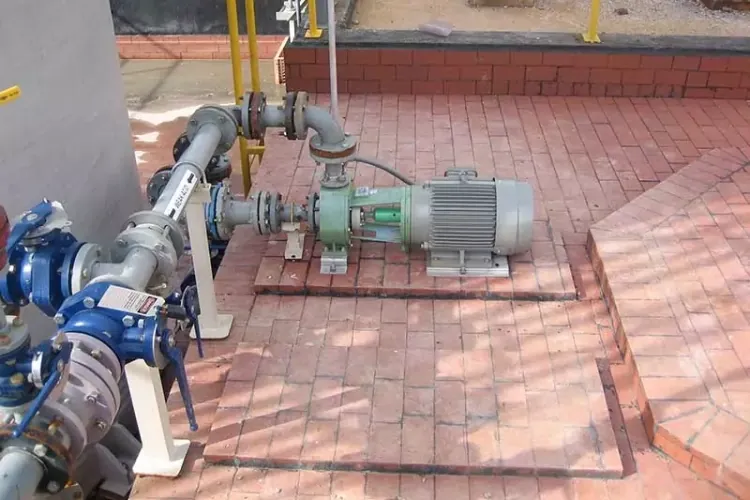
Step 5 translates the physical reality of the installation — where you are drawing from, where there is room, whether priming is possible — into a specific mechanical arrangement. The Tecnium range of corrosion-resistant plastic pumps covers the five common scenarios:
| Installation scenario | Arrangement | Series | Maximum performance |
| In-line transfer and process duty with flooded suction | Horizontal, ISO 2858 standardised | BN | 1,500 m³/h · 120 m head |
| Drawing from a bund or sump, no priming possible | Vertical sump, cantilever shaft | BT | 450 m³/h · 100 m head |
| Pumping from an external storage tank | Vertical external, hydrodynamic sealing | BV | 1,200 m³/h · 100 m head |
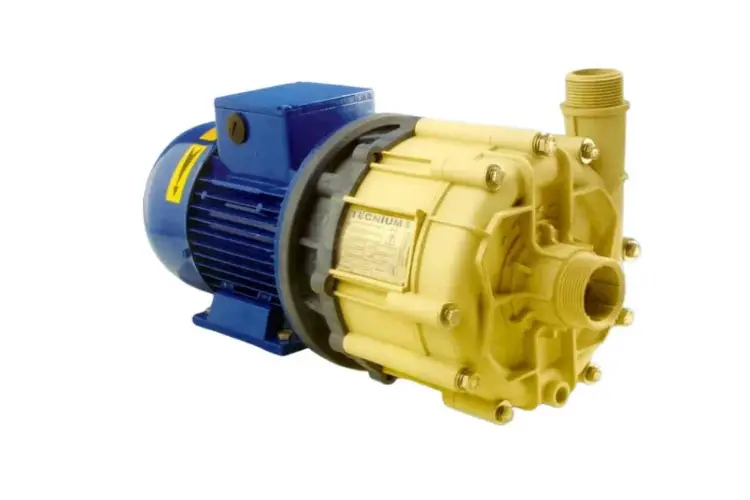
| Leakage unacceptable, DSEAR zone or ultrapure product | Magnetic drive, sealless | BKM | 50 m³/h · 45 m head |
| Dosing and transfer where space is limited | Compact close-coupled motor pump | BH · BHS · BX | 250 / 90 / 14 m³/h |
The BT vertical sump series is worth dwelling on, because it solves a case that recurs on every installation handling hazardous products: drawing from a bund. Its cantilever shaft eliminates the submerged bearing — the wear point that destroys conventional vertical pumps when particles are present — and it is designed to run dry, which is essential when the level in a bund is intermittent by definition. It covers depths of up to 1.2 metres.
Step 6 settles the sealing. For standard duty, the BN process series accepts any mechanical seal on the market and carries a seal cover that prevents any dispersion of corrosive product, with a removable shaft sleeve independent of the impeller. Where any leak is unacceptable — highly toxic, high-value or ultrapure product, or a DSEAR-classified area — the answer is the BKM magnetic drive series, with no through-shaft and no dynamic seal, and therefore zero fugitive emissions. The trade-off is a lower maximum flow and complete incompatibility with suspended solids, which block the containment shell gap. Between the two sits the BV vertical external series, which resolves sealing hydrodynamically with no mechanical seal to maintain, and the range of compact BH, BHS and BX motor pumps for dosing and transfer.
Step 7 closes the process with the paperwork. Tecnium pumps are built to ISO standards and to the European machinery safety directives, under a quality assurance system covering design and manufacture, and are available in ATEX-certified versions in categories 2 and 3 for classified areas. In the UK that certification maps onto your obligations under DSEAR 2002 and the Equipment and Protective Systems Intended for Use in Potentially Explosive Atmospheres Regulations 2016, with UKCA or CE marking as appropriate. Add to that the Pressure Equipment (Safety) Regulations 2016 where pressure and diameter thresholds are exceeded, PUWER 1998 for the equipment in service, the containment requirements that flow from your environmental permit and CIRIA C736, and BS EN ISO 2858 dimensional standardisation, which guarantees that a compliant pump is physically interchangeable with another of the same size without redesigning the installation. Ask for these documents before you place the order, not at commissioning.
Common mistakes, specification checklist and frequently asked questions
Five specification mistakes that prove expensive
Of the failures we are asked to investigate on other people’s installations, most come down to one of these five:
Specifying to nominal concentration rather than the real range. A circuit that runs «at 30 per cent» but starts every batch on undiluted product has in fact been pumping a different fluid from the one specified.
Ignoring temperature transients. Steam or hot-water cleaning exposes the material to conditions that never appeared on the process datasheet.
Oversizing «just in case». It pushes the duty point away from the BEP, raises consumption, punishes the seal and multiplies the risk of cavitation.
Choosing a magnetic drive pump for a liquid carrying particles. Probably the most expensive mistake of all: the coupling gap blocks and the unit seizes, when a vertical sump pump would have solved it.
Not checking NPSH available. All the effort put into material selection is wasted if the pump cavitates from day one.
Data checklist for requesting a technical quotation
Gathering this before you approach a manufacturer shortens the quotation cycle and, more importantly, stops the selection being made on assumptions. It is the same questionnaire our technical department works from:
Fluid: chemical name, minimum and maximum concentration, known contaminants and traces.
Conditions: normal, minimum and maximum temperature including cleaning peaks; density and viscosity at working temperature; pH.
Solids: percentage by weight, maximum particle size, abrasive or crystallising nature.
Hydraulics: rated flow and turndown range, total head, suction and discharge pressures.
Suction: static lift, pipe length and diameter, fittings, and calculated NPSH available.
Installation: what you are drawing from (line, bund, external tank), space available, duty regime (continuous, intermittent, dry running).
Compliance: DSEAR zone classification, pressure equipment applicability, and the end client’s documentation requirements.
Frequently asked questions about corrosive liquid pumps
Frequently asked questions
It is a pumping unit designed specifically to handle liquids that chemically attack conventional materials: acids, alkalis, brines, oxidisers and solvents. It differs from a standard pump in that its wetted parts are made from chemically inert materials — engineering thermoplastics or special alloys, its seal is selected for the specific fluid, and it carries the traceability and compliance documentation that handling hazardous products demands, including ATEX certification where the area is DSEAR-classified.
It depends on the combination of fluid, concentration and temperature, not on the fluid alone. As a guide: PP and PVC for standard duties at moderate temperature, PE and UHMW-PE where abrasion is the dominant problem, PVDF as the reference material for aggressive acids up to 120 °C, and E-CTFE or PTFE for the extremes: hot concentrated acids, oleum and oxidising mixtures. The table in this article covers the most common fluids, but verify compatibility for your specific case before closing the specification.
Below 120-150 °C, engineering plastic is almost always the optimal choice both technically and commercially: broader chemical resistance against reducing acids, no electrochemical corrosion, and a cost five to ten times lower than an equivalent special alloy. Metal keeps its place where temperature or pressure exceed what the thermoplastic can sustain. The comparison should not be made on purchase price but on total cost of ownership across the service life.
By ensuring the NPSH available exceeds the NPSH required by a margin of 0.5 to 1 metre. In practice that means raising the level in the suction vessel, shortening and enlarging the suction pipework, removing unnecessary bends and fittings, and checking the vapour pressure of the fluid at the maximum operating temperature rather than the nominal one. With gassing liquids such as hypochlorite you must also avoid high points where a pocket can collect and break the liquid column.
Yes, but the selection changes completely. The preferred option is the BT vertical sump series with cantilever shaft, which eliminates the submerged bearing — the point where particles cause the wear — tolerates dry running and handles up to 450 m³/h. Horizontal BN pumps with a semi-open impeller and a seal specified for solids can also be used, and UHMW-PE is worth considering for its toughness against abrasion. Magnetic drive pumps are ruled out: the coupling gap blocks.
With the right material and basic preventive maintenance — visual inspection of the seal, monitoring of service temperature and critical spares held in stock — a Tecnium pump can exceed 10 years in continuous service on aggressive chemicals, against the 12 to 24 months typical of a standard metal pump on the same duty. The back pull-out design allows the bearing frame, impeller, shaft and seal to be separated without dismantling the suction and discharge pipework or the motor, and the mechanical seal to be replaced without changing the impeller, so interventions are short and downtime minimal.
If you need to specify a pump for corrosive liquids on your installation, the Tecnium technical team can review your process conditions and propose the optimal series, material and sealing arrangement, with the full compliance documentation. Request a no-obligation quotation and get advice from a manufacturer with more than 70 years of experience pumping corrosive fluids for the chemical, fertiliser, surface treatment, mining, pharmaceutical and water treatment industries.
How can we help you?
Tell us about your application and we will advise you the most optimal solution to solve your needs of gas treatment, odor control and storage and pumping of corrosive fluids.