Chemical Pump Types: A Selection Guide by Application
Across the chemical, pharmaceutical, fertiliser and water treatment industries — and dozens of adjacent sectors — pumps are the heart of any process that moves a corrosive or abrasive fluid. Choosing the right type of pump is no small decision: it directly affects plant safety, process performance, maintenance cost and the service life of the equipment.
What a chemical pump is and how it differs from a conventional water pump.
The five main families of chemical pump: horizontal process, magnetic drive, vertical sump, vertical external and close-coupled motor pumps.
Recommended Tecnium series (BN, BKM, BT, BV, BH/BX) with flow rates, heads and typical duties.
How to select the right pump based on fluid, flow, temperature, solids, ATEX zoning and budget.
Applicable thermoplastic materials, UK regulatory framework, maintenance and sector experience.
Across the chemical, pharmaceutical, fertiliser and water treatment industries — and dozens of adjacent sectors — pumps are the heart of any process that moves a corrosive or abrasive fluid. Choosing the right type of pump is no small decision: it directly affects plant safety, process performance, maintenance cost and the service life of the equipment.
The difficulty is that there is no universal pump. Every duty — transferring concentrated sulphuric acid, dosing sodium hypochlorite, emptying a containment bund, handling a liquid carrying suspended solids, operating inside an ATEX zone — calls for a different pump type, with its own materials, configuration and ancillaries. A specification error leads to premature corrosion, leaks, unplanned shutdowns and costs that compound across the whole life of the asset.
Tecnium, Spanish manufacturer of corrosion-resistant plastic pumps since 1957, designs and manufactures a complete range of centrifugal pumps for chemical duties — horizontal, vertical, magnetic drive and close-coupled — in advanced thermoplastics (PP, PVDF, PVC, PE, E-CTFE) machined from solid block. This guide reviews the main chemical pump types, when to choose each one and which technical criteria to apply when specifying.
What a chemical pump is and why it differs from a conventional pump
Definition and distinguishing features
A chemical pump is any pumping unit specifically designed to handle corrosive, toxic, flammable or abrasive fluids under industrial conditions. Unlike a conventional water pump — built in cast iron, bronze or carbon steel — a chemical pump is specified to withstand chemical attack from the pumped fluid, to contain hazardous leakage and to run reliably under temperature, pressure and solids loading that can be severe.
Five features set a chemical pump apart: corrosion-resistant materials of construction, a mechanical seal matched to the fluid, hydraulic design that minimises wear, regulatory compliance (ATEX or UKEX, PUWER, COMAH) and full traceability of materials and test records. The result is a higher purchase price than a standard pump, but a markedly lower total cost of ownership thanks to a service life measured in years rather than months.
Materials of construction for aggressive chemicals
The material of the casing, impeller, shaft and gaskets determines which chemicals a pump can handle and under what conditions. Tecnium machines its components from solid-block plastic — not linings or moulded parts — which guarantees that the full thickness of every component offers the same chemical resistance. The five thermoplastic families available are:
| Material | Max. service temp. | Resistance and typical duty |
| Polypropylene (PP) | 60-90 °C | Excellent resistance to dilute acids, alkalis and saline solutions. Cost-effective choice for standard duties. |
| Polyethylene (PE) | 60 °C | Chemically similar to PP, with particularly good abrasion resistance. Suited to clean liquids and suspensions at moderate temperature. |
| PVC | 40-50 °C | Good resistance to acids and hypochlorites. A classic material with excellent value for environmental service duties. |
| PVDF | 100-120 °C | The reference material for aggressive chemicals. Withstands HCl, H₂SO₄, HF and hypochlorites. High stiffness and abrasion resistance. |
| E-CTFE | 150 °C | Fluoroplastic, weldable in inert atmosphere. Maximum chemical resistance to virtually any product, including oleum and hot concentrated acids. |
The UK regulatory framework: what applies to a chemical pump
Chemical pumps must satisfy a set of technical standards and statutory requirements covering interchangeability, safety and traceability. For a plant operating in Great Britain the framework changed after Brexit, so it is worth being precise about what applies:
ISO 2858 / EN 22858: the dimensional standard for horizontal centrifugal process pumps. It ensures that any compliant pump is physically interchangeable with another of the same size, allowing replacement without redesigning the installation.
DSEAR and UKEX (formerly ATEX): in Great Britain, the Dangerous Substances and Explosive Atmospheres Regulations apply, with UKCA-marked equipment under the UKEX regime. ATEX 2014/34/EU still applies in Northern Ireland and for equipment exported to the EU, so most plants specify dual certification. Tecnium supplies certified versions in categories 2 and 3.
COMAH 2015: the Control of Major Accident Hazards Regulations govern sites holding hazardous substances above threshold quantities. They drive requirements for bunding, containment, leak detection and documented equipment traceability.
PUWER 1998: the Provision and Use of Work Equipment Regulations require that pumps be suitable for their intended use, properly maintained and accompanied by adequate information and training.
Pressure Equipment (Safety) Regulations 2016: the GB implementation of the former PED, applicable to pumps and ancillaries once the installation exceeds defined pressure and diameter thresholds.
A practical note for buyers: since January 2023 the UKCA mark has been required for equipment placed on the Great Britain market, although CE marking continues to be accepted for most product categories under successive extensions. Requesting both markings on the technical dossier is the safest route for plants that also operate sites in Ireland or continental Europe.
The five main Tecnium chemical pump types
The Tecnium range of corrosion-resistant plastic pumps is structured into five families, each optimised for a different type of duty. The table below summarises the series and their key performance data:
| Series | Type | Max. flow | Max. head | Typical duty |
| BN | Horizontal process, ISO 2858 | 1,500 m³/h | 120 m | Chemical process, fertilisers, high-volume transfer |
| BH / BX | Compact close-coupled motor pump | 250 m³/h | 80 m | Dosing and transfer in mid-size plants |
| BT | Vertical sump (cantilever shaft) | 450 m³/h | 100 m | Suction from bunds and tanks carrying solids |
| BV | Vertical, external to tank | 1,200 m³/h | 100 m | Pumping from storage tanks with hydrodynamic sealing |
| BKM | Magnetic drive, sealless | 50 m³/h | 45 m | ATEX zones, ultrapure chemicals, zero emissions |
Horizontal process pumps (BN series)
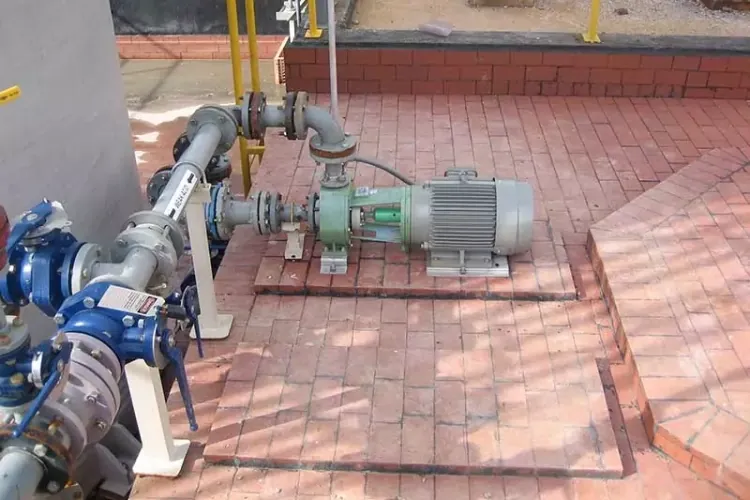
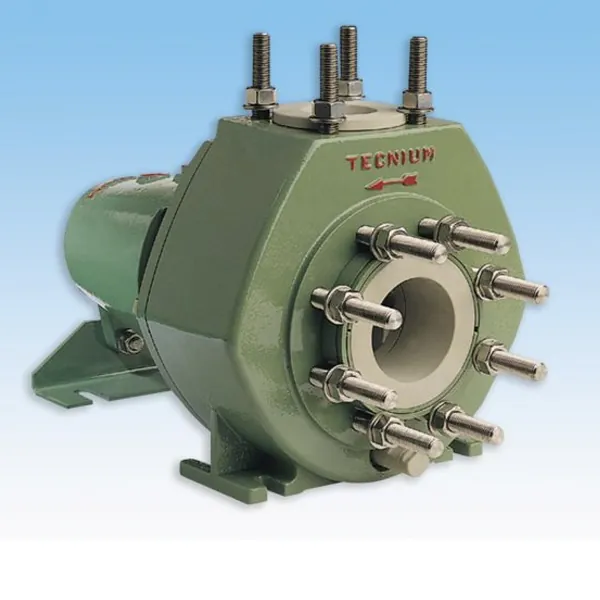
The BN series is the definitive process pump for the chemical industry. Standardised to ISO 2858 / EN 22858, it accepts any mechanical seal on the market and is manufactured in six different plastics (PP, PVDF, PVC, PE, E-CTFE, PVDF-HP). Flows reach 1,500 m³/h and heads 120 metres of liquid column.
It is the default choice for reagent transfer in chemical plants, reactor feed, high-volume dosing, fertiliser production and refining duties. Its back pull-out design allows the pump to be stripped without disturbing the pipework or moving the motor, which sharply reduces maintenance time on site.
Sealless magnetic drive pumps (BKM series)
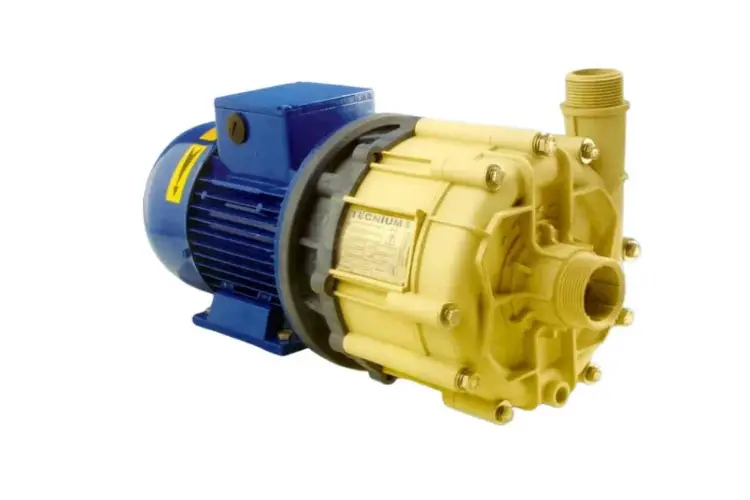
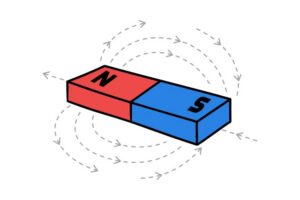
The BKM series removes the mechanical seal altogether. Torque is transmitted to the impeller through a magnetic coupling across a hermetic containment shell, guaranteeing absolute leak-tightness and zero fugitive emissions. There is no through shaft, no dynamic gasket and no possibility of leakage through seal wear.
It is the mandatory option for pumping ultrapure or highly toxic chemicals, in ATEX-classified zones, or wherever any leak is unacceptable on safety, environmental or process-purity grounds. Typical duties: anhydrous HCl, concentrated sulphuric acid, oleum, chlorinated solvents, electronic-grade and pharmaceutical chemicals. Flows up to 50 m³/h and heads up to 45 metres.
Vertical pumps: sump (BT) and external to tank (BV)
Vertical pumps solve the situations where the pump must draw directly from a tank or containment pit without priming. Tecnium offers two distinct configurations:
BT vertical sump series (cantilever shaft): no bearing submerged in the liquid, which makes it ideal for liquids carrying suspended solids (pickling effluent, mining leachate, wash water). Flows up to 450 m³/h and heads up to 100 m.
BV vertical external series: pumping from storage tanks with hydrodynamic sealing (no mechanical seal). Flows up to 1,200 m³/h. A very robust solution for large reagent farms.
To these are added the BH and BX compact horizontal motor pumps, designed for dosing, transfer and installations with limited space. They cover flows up to 250 m³/h and are the most economical solution for mid-size plants and intermittent transfer duties.
Selection by application, maintenance and frequently asked questions
How to select the right pump for the fluid and the process
Selecting the right pump means assessing several process parameters together. A systematic approach avoids the most common specification errors:
Nature of the fluid: chemical type, concentration, temperature, viscosity, density and solids content. This determines the casing and impeller material (see the compatibility table above).
Flow rate and total head: these define the size and the series. The duty point should sit within the preferred operating region around the best efficiency point (BEP) of the pump curve.
Installation configuration: horizontal on a baseplate (BN), vertical sump (BT), vertical external (BV), compact motor pump (BH/BX) or magnetic drive (BKM).
Containment requirements: for highly toxic chemicals, in ATEX or DSEAR-classified zones, or wherever leakage is unacceptable, the sealless BKM series is the mandatory choice. For standard duties, a correctly specified mechanical seal delivers excellent performance.
Solids content: for liquids carrying particles, the BT vertical series without a submerged bearing is the preferred option.
Applicable regulations: DSEAR, COMAH, PUWER and sector-specific rules shape both the specification and the documentation package required for the equipment.
Maintenance and service life of chemical pumps
Effective maintenance of a chemical pump focuses on three points: the mechanical seal, shaft alignment and process temperature. The back pull-out design of Tecnium pumps gives access to the seal and impeller without dismantling the pipework or the motor, which sharply reduces intervention time.
With correct material specification and basic preventive maintenance — visual seal inspection, monitoring of operating temperature and critical spares held in stock — a Tecnium pump can exceed 10 years of service life in continuous duty, compared with the 12-24 months typical of standard metallic pumps handling aggressive chemicals. That differential is the most compelling economic argument against metallic alternatives.
Frequently asked questions about chemical pump types
Frequently asked questions
A chemical pump is any pumping unit specifically designed to handle corrosive, toxic, flammable or abrasive fluids. It differs from a conventional pump in its materials of construction (advanced thermoplastics or special alloys), its fluid-matched mechanical seal, its regulatory compliance (DSEAR, COMAH, PUWER) and its ability to run reliably with liquids that would rapidly degrade a standard cast-iron or carbon-steel pump.
Metallic pumps (Hastelloy, titanium, super duplex) withstand very high temperatures (above 200 °C) and pressures, but they cost 5-10 times more than a plastic equivalent and their resistance to acids such as HCl or oxidising mixtures is limited. Technical plastic pumps (PVDF, PP, E-CTFE) offer universal chemical resistance, no electrochemical corrosion, low weight and a far lower total cost of ownership. For the majority of industrial duties below 120 °C, plastic is the technically and economically optimal choice.
A magnetic drive pump (BKM series) is chosen where any leak is unacceptable: highly toxic, high-value or ultrapure chemicals, ATEX or DSEAR zones, or installations under stringent environmental regulation. The trade-off is a lower maximum flow (50 m³/h) and no tolerance of suspended solids. For conventional transfer and process duties with standard chemicals, a correctly specified mechanical seal pump (BN series) delivers excellent performance and higher flow at lower cost.
E-CTFE is the thermoplastic with the broadest chemical resistance: it withstands virtually any acid, base, salt and solvent across the full concentration range and up to 150 °C. PVDF follows (excellent up to 120 °C and the most commonly specified). PTFE is more resistant still, but is used mainly in gaskets and seals because of its mechanical limitations. PP and PVC cover the majority of standard duties at moderate temperature with excellent value for money.
Yes, but it requires a specific selection. The BT vertical sump series with cantilever shaft is the preferred option for liquids carrying solids (pickling effluent, leachate, wash water) because it eliminates the submerged bearing, the main wear point when particles are present. BN pumps with a semi-open impeller and a solids-rated mechanical seal can also be used. Magnetic drive pumps are never recommended for liquids with particles: the containment shell gap can become blocked.
With correct material specification and basic preventive maintenance, a Tecnium pump can exceed 10 years of service life in continuous duty with aggressive chemicals, compared with the 12-24 months typical of standard metallic pumps. Wear components (mechanical seal, gaskets) are replaced periodically without needing to replace the casing, and the back pull-out design makes those interventions quick, minimising downtime.
If you need to define the right chemical pump types for your plant or process, the Tecnium technical team can help you map each duty to the optimal series, material and sealing arrangement. Request a no-obligation quotation and receive personalised advice from a manufacturer with more than 70 years of experience in pumping corrosive fluids for the chemical, fertiliser, mining, pharmaceutical and water treatment industries.
How can we help you?
Tell us about your application and we will advise you the most optimal solution to solve your needs of gas treatment, odor control and storage and pumping of corrosive fluids.