Energy Efficiency in Gas Scrubbing: How Tecnium Systems Cut Industrial Consumption
Energy costs have become one of the heaviest lines in industrial OPEX. Within a chemical, pharmaceutical, waste treatment or wastewater plant, gas treatment systems — scrubbers, biofilters, thermal oxidisers — can account for between 5 % and 20 % of total electricity consumption, depending on the technology and the design. Against a backdrop of volatile wholesale prices, tightening emissions regulation and corporate decarbonisation commitments, the energy efficiency of gas scrubbing has stopped being a secondary consideration and become a decisive competitive factor.
Why energy efficiency in gas scrubbing has become a critical component of industrial OPEX.
Consumption comparison across biofiltration, biotrickling, wet scrubbers, thermal oxidation and activated carbon.
How Tecnium optimises every component of the system: packing, pumps, fans and control.
Operational best practice to cut electrical and thermal consumption by up to 40 %.
Sector applications: WWTPs, chemicals, MBT plants, fertilisers and pulp & paper.
Energy costs have become one of the heaviest lines in industrial OPEX. Within a chemical, pharmaceutical, waste treatment or wastewater plant, gas treatment systems — scrubbers, biofilters, thermal oxidisers — can account for between 5 % and 20 % of total electricity consumption, depending on the technology and the design. Against a backdrop of volatile wholesale prices, tightening emissions regulation and corporate decarbonisation commitments, the energy efficiency of gas scrubbing has stopped being a secondary consideration and become a decisive competitive factor.
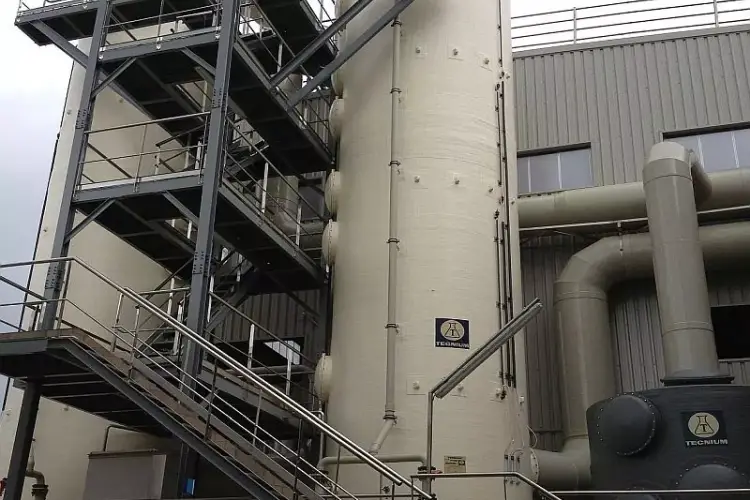
Tecnium, Spanish manufacturer of corrosion-resistant fluid-handling and gas-treatment equipment since 1957, designs and manufactures gas scrubbing systems that are energy-optimised from the outset: low pressure-drop packing, corrosion-resistant pumps with high hydraulic efficiency, thermoplastic fans under variable-speed control, intelligent recirculation systems and biological technologies (biofiltration and biotrickling) that dramatically reduce both electrical and thermal consumption compared with conventional alternatives.
This guide examines why energy efficiency is now a non-negotiable requirement in gas scrubbing, which technologies consume least, how Tecnium optimises each component of the system, and which operational measures can cut consumption by up to 40 % on existing installations.
Why energy efficiency is critical in gas scrubbing
The energy cost of industrial gas treatment
In a typical industrial installation, a gas treatment system consumes energy on three fronts: extracting and moving the gas (fans), circulating the scrubbing liquid (pumps) and — in some technologies — supplying heat (burners, heaters). To these must be added the consumables (chemical reagents, activated carbon, natural gas), which carry an indirect energy cost in their manufacture and transport.
The orders of magnitude are telling. A regenerative thermal oxidiser (RTO) can consume between 0.5 and 2 kWh of electricity per 1,000 Nm³ of gas treated, plus 3-10 kWh equivalent in natural gas. A conventional chemical scrubber sits at 0.4-1 kWh/1,000 Nm³ in electricity alone, before reagents. Against those figures, a properly sized biofilter or biotrickling filter can operate on less than 0.3 kWh/1,000 Nm³ with no thermal consumption and minimal reagent use.
The UK regulatory framework: EPR, ESOS, UK ETS and SECR
British regulation pushes decisively towards energy efficiency in emissions treatment. Since Brexit the framework has diverged from the EU one, so it is worth being precise about what actually applies to a plant operating in Great Britain:
Environmental Permitting Regulations 2016 (EPR): the GB regime that retained the substance of the Industrial Emissions Directive. Permitted installations must apply Best Available Techniques (BAT), and UK BAT Conclusions include explicit energy efficiency criteria. Regulated by the Environment Agency in England, SEPA in Scotland and Natural Resources Wales.
ESOS (Energy Savings Opportunity Scheme): requires large undertakings to carry out energy audits every four years and, since Phase 3, to publish an action plan setting out the measures they intend to implement. Gas treatment systems are frequently among the largest uncatalogued electrical loads on site.
UK Emissions Trading Scheme (UK ETS): operating independently since 2021, it puts a price on fossil fuel consumption and therefore penalises gas-intensive technologies such as thermal oxidation. The scheme’s scope is being extended progressively, and linkage arrangements with the EU ETS are under negotiation.
Climate Change Levy (CCL): a direct tax on business energy use. Sites within a Climate Change Agreement can obtain significant relief in exchange for meeting agreed efficiency targets — which makes any consumption reduction doubly valuable.
SECR (Streamlined Energy and Carbon Reporting): obliges large companies to disclose their energy use and Scope 1 and 2 emissions in their annual accounts, together with the efficiency measures taken. Gas treatment consumption falls squarely within that disclosure.
Impact on OPEX and industrial competitiveness
In practical terms, every point of energy efficiency in the gas scrubbing system translates directly into annual savings and competitive advantage. For a typical installation of 20,000 Nm³/h running 8,000 hours a year, a difference of 0.3 kWh/1,000 Nm³ between two designs amounts to roughly 48,000 kWh per year — around £7,000 to £10,000 on the electricity bill alone at current industrial rates, before counting avoided emissions, CCL exposure and the improvement in ESG reporting.
At the scale of a large installation (100,000 Nm³/h at a chemical complex or a municipal WWTP), the gap between a conventional design and an optimised one can reach hundreds of thousands of pounds a year. That differential is what makes the choice of technology and supplier a strategic decision rather than a purely technical one.
How Tecnium achieves maximum energy efficiency in gas scrubbing
Technology selection: biofiltration and biotrickling versus conventional alternatives
The single most important decision for energy efficiency is taken at concept stage, when the technology is chosen. The Tecnium range of gas treatment technologies allows the optimal solution to be selected according to contaminant, flow rate and concentration. The table below summarises the energy balance of the five main families:
| Technology | Specific electrical consumption | Thermal / reagent consumption | Overall energy balance |
| Biofiltration | Low (ventilation only) | None | Very favourable |
| Biotrickling filter | Low-medium (ventilation + recirculation) | Low (nutrients, pH control) | Very favourable |
| Wet scrubber | Medium (ventilation + pumping) | Medium-high (chemical reagents) | Medium |
| Thermal oxidation (RTO) | High (ventilation + burner) | Very high (natural gas) | Unfavourable |
| Activated carbon | Low (ventilation only) | High (periodic media replacement) | Medium-unfavourable |
The operational conclusion is clear: for biodegradable contaminants (VOCs, H₂S, NH₃, mercaptans) at dilute or medium concentrations, Tecnium’s biological technologies are between five and ten times more energy-efficient than thermal oxidation and appreciably better than a chemical scrubber. Reserving thermal oxidation strictly for non-biodegradable contaminants or very high concentrations is the first major efficiency lever.
Optimised hydraulic design: packing, geometry and velocities
Within each technology, hydraulic design makes the difference. In Tecnium scrubbers and biotrickling filters, energy efficiency is optimised through four design levers:
Low pressure-drop packing: high-voidage structured and random packing (Pall rings, structured bodies) that reduces pressure drop compared with conventional media, minimising fan consumption.
Optimised superficial velocity: sizing the tower diameter to operate at 1.5-2.5 m/s reduces friction losses without compromising mass transfer efficiency.
Tuned liquid-to-gas (L/G) ratios: matching the recirculation flow to the solubility of the contaminant avoids pumping more liquid than necessary, cutting recirculation pump consumption.
Uniform liquid distribution: nozzles and distributors designed to ensure complete wetting of the bed, preventing the channelling that would otherwise force the irrigation flow to be oversized.
High-efficiency corrosion-resistant pumps and fans
The two largest electrical loads in a gas scrubbing system are the extraction fan and the recirculation pumps. Tecnium manufactures both in corrosion-resistant thermoplastics with optimised designs:
Tecnium plastic fans (PP, PPs, PVC, FRP): optimised aerodynamic design and high-efficiency impellers, with variable frequency drive (VFD) control that matches speed to the actual flow demand and eliminates the waste inherent in damper or bypass regulation.
Corrosion-resistant recirculation pumps: BN, BT and BV series in PP, PVDF and PVC, with duty points placed within the preferred operating region around the best efficiency point (BEP). Correctly specified, they deliver hydraulic efficiencies of 70-80 %.
Intelligent automatic control: contaminant sensors combined with variable-speed drives allow modulating operation, reducing gas and liquid flow when the load is low. On existing installations, replacing throttling valves with VFDs can cut consumption by 20-30 %.
Best practice, sector applications and frequently asked questions
Operational best practice to maximise energy efficiency
Beyond the design, day-to-day operation has an enormous impact on real consumption. The practices Tecnium recommends to its clients are:
Baseline energy audit: measure the actual consumption of fans, pumps and heaters and compare it against the design curves. This alone identifies inefficient duty points — and for many sites it doubles as evidence towards ESOS compliance.
Preventive maintenance of packing and pumps: fouled packing multiplies pressure drop and fan consumption. A simple periodic wash can cut consumption by 15-20 %.
Gas flow control via VFD: rather than dampers or bypass, variable-speed control matches flow dynamically to real demand, saving between 20 % and 40 % of fan consumption.
Liquid recycling and recirculation: minimising blowdown and maximising recirculation reduces fresh water consumption, reagent use and the associated pumping load.
Segmentation by source: treating streams of different concentration separately, with technology matched to each, avoids oversizing a single system for peak load.
Sector applications
Energy-efficient Tecnium systems are in operation across multiple sectors where gas treatment consumption is particularly significant:
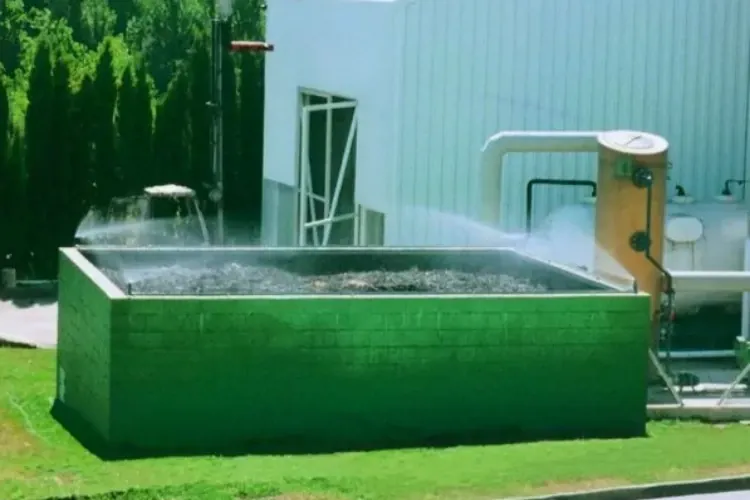
WWTPs and wastewater plants: biotrickling filters and biofilters for H₂S and odour removal, with consumption up to ten times lower than thermal oxidation. A recurring duty across UK water utilities under odour management obligations.
Chemical and pharmaceutical industry: multi-stage scrubbers with reagent recovery and polishing biofilters, minimising the replenishment of costly chemicals.
MBT and waste treatment plants: high-flow biofilters for odour abatement in reception halls, mechanical-biological treatment areas and composting tunnels, at minimal energy cost.
Fertilisers: acid scrubbers that valorise the ammonium sulphate generated as a saleable by-product, turning the blowdown into an additional revenue stream.
Pulp and paper: biotrickling filters and bioscrubbers for mercaptans and reduced sulphur compounds at very low operating cost.
Biogas and biomethane: biological desulphurisation of biogas with no reagent or fuel consumption, supporting the valorisation of biomethane as renewable energy — a fast-growing segment under the UK’s Green Gas Support Scheme.
Frequently asked questions about energy efficiency in gas scrubbing
Frequently asked questions
It depends entirely on the technology. A biofilter or biotrickling filter consumes between 0.2 and 0.4 kWh per 1,000 Nm³ treated; a chemical scrubber between 0.4 and 1 kWh/1,000 Nm³ plus reagents; an RTO can reach 2 kWh/1,000 Nm³ of electricity plus 3-10 kWh equivalent in natural gas. Selecting the right technology for the contaminant and concentration is the single largest saving lever available.
For biodegradable contaminants (VOCs, odours, H₂S, NH₃, mercaptans) at low or medium concentrations, biological technologies — biofiltration and biotrickling — are clearly the most efficient: low electrical consumption, no thermal load and no costly reagents. For non-biodegradable contaminants or very high concentrations, a well-designed multi-stage scrubber is the better option; thermal oxidation should be reserved for cases where no alternative exists.
The three highest-impact measures on an existing installation are: fitting variable frequency drives to fans and pumps (20-40 % saving), carrying out periodic packing maintenance to prevent fouling (15-20 %), and optimising the L/G ratio and superficial velocity through a targeted redesign (10-20 %). Tecnium offers energy audits and retrofit projects for existing plants.
Almost always. A VFD on the extraction fan and recirculation pumps typically pays back within one to three years on installations running at variable load. Beyond cutting electricity consumption, it extends motor life by removing hard starts and reduces maintenance on mechanical regulation valves. On sites within a Climate Change Agreement, the saving also counts towards the agreed efficiency target.
For medium flows (10,000-50,000 Nm³/h) with soluble, biodegradable contaminants, a biotrickling filter can cut total energy consumption by 80-95 % compared with a regenerative thermal oxidiser. On top of that come the elimination of natural gas consumption, the associated CO₂ emissions, the UK ETS exposure and the CCL charge. Total cost of ownership for a biotrickling filter typically comes in at half that of an equivalent RTO or less.
Decisively. A modern low pressure-drop structured packing can reduce fan consumption by 20-40 % compared with older or poorly selected random packing. It also determines the specific surface area (m²/m³), which drives mass transfer efficiency and therefore the overall size of the unit, as well as resistance to fouling. Tecnium selects the optimal packing for each application based on the contaminant, its solubility and the operating conditions.
If you are looking to improve the energy efficiency of gas scrubbing at your site — on a new plant or as a retrofit to existing equipment — the Tecnium technical team can carry out an energy audit and propose the optimal solution: technology selection, hydraulic redesign, variable frequency drives and intelligent automatic control. Request a no-obligation quotation and receive personalised advice from a manufacturer with more than 70 years of experience in industrial gas treatment.
How can we help you?
Tell us about your application and we will advise you the most optimal solution to solve your needs of gas treatment, odor control and storage and pumping of corrosive fluids.