A complete guide of biofiltration for industrial air pollution control
Industrial air pollution is one of the major environmental challenges of the 21st century. Emissions of volatile organic compounds (VOCs), odours and acidic gases generated by industrial activity are subject to increasingly strict regulation — the Industrial Emissions Directive 2010/75/EU (IED), national environmental permits, sector-specific BREF documents and equivalent rules in the UK and rest of Europe — that forces companies to deploy treatment technologies that are effective, reliable and economically sustainable.
Industrial air pollution is one of the major environmental challenges of the 21st century. Emissions of volatile organic compounds (VOCs), odours and acidic gases generated by industrial activity are subject to increasingly strict regulation — the Industrial Emissions Directive 2010/75/EU (IED), national environmental permits, sector-specific BREF documents and equivalent rules in the UK and rest of Europe — that forces companies to deploy treatment technologies that are effective, reliable and economically sustainable.
Of all the available solutions, biofiltration has established itself as the most efficient option to remove odours and VOCs at low concentrations and medium-to-high flow rates. It leverages the metabolic capacity of living microorganisms to break pollutants down into water, CO₂ and biomass, with no secondary effluent or hazardous waste.
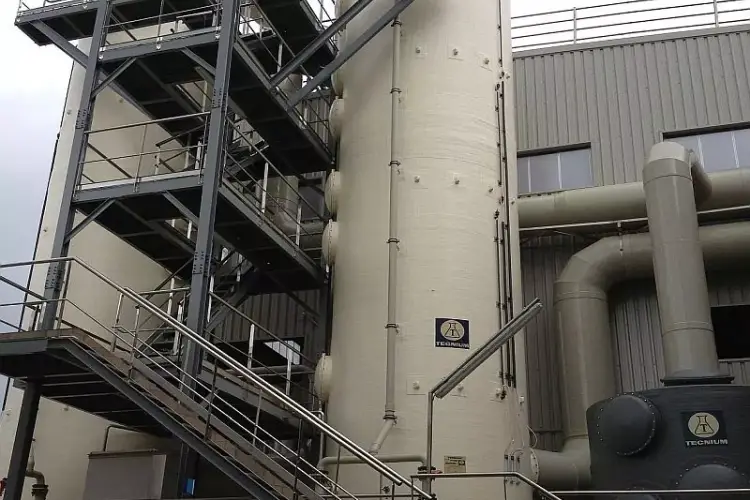
Tecnium, Spanish manufacturer of corrosion-resistant fluid-handling and gas-treatment equipment since 1957, designs, manufactures and installs complete turnkey biofiltration systems. Its plants are built using corrosion-resistant materials — polypropylene (PP), fibreglass-reinforced polyester (FRP), PVC and PVDF — and have solved air pollution problems in chemical, pharmaceutical, food, WWTP, fertiliser, pulp & paper and waste-treatment industries across more than twenty countries.
In this guide we examine what biofiltration is, how it works, what advantages it offers over other technologies and how to size a system correctly for a specific industrial application.
What biofiltration is and how it works as an air pollution control technology
Biofiltration is a clean biological gas-treatment technology that uses the metabolic activity of microorganisms to remove contaminants present in an air stream. Unlike physico-chemical methods — which transfer the pollutant from the gas phase to another phase (liquid, solid) — biofiltration destroys it completely, turning it into inert compounds and new biomass.
Biological principle: gas cleaning through microorganisms
The fundamentals of biofiltration are simple yet remarkably effective. The contaminated air stream is forced to flow through a porous filter bed (biomass) — typically made up of mixtures of peat, compost, wood fibre, wood chips, heather, root material or other natural substrates — on which an active population of bacteria, fungi and other aerobic microorganisms develops.
These microorganisms form a moist biofilm around the support particles. As the contaminated air passes through the bed, organic and inorganic pollutants transfer from the gas phase into this biofilm and are metabolised by the microorganisms as a source of carbon and energy. The end products of the process are water, carbon dioxide and new biomass, all of which are harmless.
For the process to achieve high removal efficiencies, the gas must be conditioned beforehand: controlled temperature (20-40 °C), relative humidity close to 95-100 %, no dust and no bactericidal contaminants (high concentrations of solvents, strong acids, heavy metals) that could harm the microbial population. This conditioning is typically achieved in a humidification stage upstream of the biological bed.
Components of an industrial biofiltration system
An industrial biofiltration plant is made up of several elements that work together. Each component performs a specific function and must be sized correctly to guarantee the overall performance of the system:
- Gas capture and ducting: hoods, ducts and fans that collect contaminated air at the emission sources and transport it to the treatment unit. Tecnium manufactures ducts and fans in PP, PE, PVDF and FRP to ensure corrosion resistance.
- Conditioning chamber (humidification): unit where the gas is humidified and cooled to the optimal conditions for the microorganisms. It usually incorporates spray nozzles and structured packing.
- Filter bed (biomass): support material where the microorganisms live. Its typical depth ranges between 1 and 2 metres and its composition is selected according to the type of contaminant (peat, compost, heather, wood chips, inert mineral supports or specific mixtures).
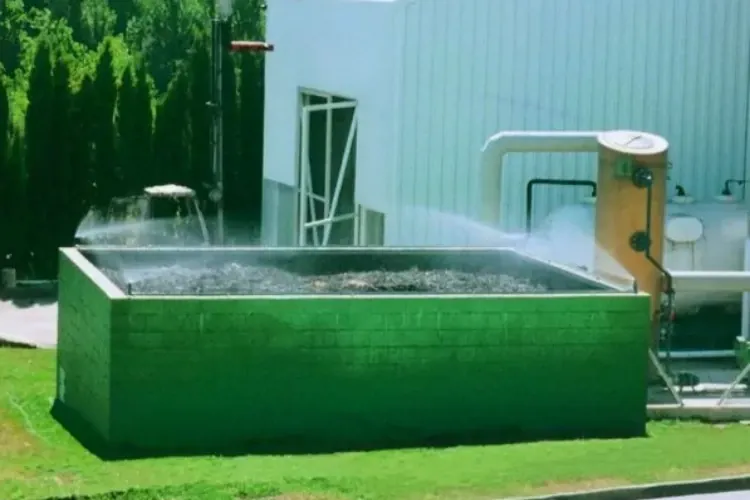
- Containment structure: depends on the technology. For biotrickling filters and bioscrubbers, Tecnium manufactures the basin, modular container or silo in FRP and corrosion-resistant thermoplastic materials suited to environments with aggressive gases. For fixed-bed biofilters, the structure is usually built as a civil-works basin (concrete) executed by the client; Tecnium provides the design calculations and the filter-bed dimensions.
- Irrigation and drainage system: maintains the optimal moisture of the bed and collects the leachate generated, which can be recirculated to preserve the microbial flora.
- Control instrumentation: sensors for temperature, humidity, pressure drop and, in advanced installations, VOC or H₂S probes to validate removal efficiency in real time.
Components of an industrial biofiltration system
There are three main families of biological technologies, each with its own optimal field of application. The choice between them depends on the contaminant, its water solubility, gas flow rate and available footprint:
- Fixed-bed biofilter: the classic configuration. Gas flows upward through a static bed of organic biomass. It is the most economical and robust option for odours and poorly soluble VOCs. Tecnium offers civil-works solutions (concrete basins with diffusers), modular ones (stackable containers) and on FRP basins.
- Biotrickling filter (percolator): the bed is built from inert support (plastic rings, ceramic) over which an aqueous nutrient solution is continuously sprayed. Ideal for soluble contaminants such as H₂S, NH₃ or mercaptans and for higher concentrations. Allows tighter pH and temperature control.
- Bioscrubber: a combination of a conventional scrubber (water absorption) with an independent biological reactor that degrades the absorbed contaminants. Suitable for highly soluble pollutants or when fine process control is required.
Advantages and applications of biofiltration to reduce atmospheric pollution
Biofiltration is not the only technology available to reduce industrial air pollution, but it is the most efficient option when certain process conditions are met. To understand its real value it helps to compare it with the usual alternatives and to know which compounds it can remove.
Advantages over other gas-treatment technologies
Industrial plants usually evaluate several options — activated carbon, thermal oxidation, chemical scrubber — before choosing biofiltration. The table below summarises the comparison for a typical application of odour or low-concentration VOC treatment:
| Criterion | Biofiltration | Activated carbon | Thermal oxidation | Chemical scrubber |
|---|---|---|---|---|
| Removal efficiency | 90-99 % | 95-99 % | 95-99 % | 80-99 % |
| Capital cost | Medium | Low | High | Medium |
| Operating cost | Very low | High (carbon replacement) | High (fuel) | Medium (reagents) |
| Energy consumption | Low | Low | Very high | Medium |
| Waste generated | Compostable biomass | Saturated carbon (hazardous) | None (combustion) | Saline effluent |
| Best for | VOCs and odours | Medium concentrations | High concentrations | Soluble acidic and alkaline gases |
| Link to technology | Click here | Click here | Click here | Click here |
The three core advantages highlighted in Tecnium’s technical brochure are confirmed in practice: low operating cost (no reagents or fuel consumed), versatility (a single unit can treat complex mixtures of VOCs and odours) and the absence of polluting discharges.
Removable compounds: VOCs, odours, H₂S and other contaminants
Biofiltration is capable of degrading a wide variety of atmospheric pollutants, provided they are biodegradable and the process conditions are met. The main groups are:
- Volatile organic compounds (VOCs): alcohols (ethanol, isopropanol), ketones (acetone, MEK), aldehydes (formaldehyde, acetaldehyde), esters (ethyl acetate), aromatic hydrocarbons (BTEX at low concentrations), terpenes and oxygenated solvents in general.
- Sulphur compounds: hydrogen sulphide (H₂S), mercaptans, sulphides and organic disulphides. They are the main culprits behind odours in WWTPs, sludge plants, slaughterhouses and composting.
- Nitrogen compounds: ammonia (NH₃), amines and other nitrogen derivatives typical of slurry, fertilisers and anaerobic digestion processes. Their treatment by biofiltration is only viable at low concentrations, since at higher concentrations they can inhibit the bacterial activity of the bed.
- Complex odours: mixtures of hundreds of compounds at very low concentrations, typical of waste-treatment plants, livestock facilities, food industries and urban WWTPs.
Not every contaminant is suitable for biofiltration: highly refractory compounds (PFCs, heavy chlorinated compounds), gases at concentrations so high they become toxic for the microorganisms, and streams at temperatures above 50-60 °C or untreated acidic gases fall outside the optimal field of application.
Industrial sectors using biofiltration on a daily basis
Tecnium’s gas treatment technologies, including its industrial biofiltration range, have been installed in sectors with real biofiltration and air pollution challenges. A few representative examples from its industrial track record:
- WWTPs and wastewater plants: deodorisation of sources such as inlet pumping, filter rooms, sludge thickeners and dewatering. Tecnium has delivered installations with flow rates of up to 40,000 Nm³/h in urban WWTPs.
- Pharmaceutical industry: removal of VOCs from reactors, dryers and packaging areas. Modular solutions in stackable containers allow progressive scale-ups and are common in this sector.
- Food and dairy industry: a historic reference of Tecnium is an installation at a dairy-derivatives industry in Spain (1998) for VOC removal with a 4,000 Nm³/h flow rate, still in operation decades later.
- Waste-treatment plants (MSW/MBT) and composting: odour control in reception halls, mechanical-biological treatment and composting tunnels.
- Fertilisers and slurry: removal of NH₃ and sulphur compounds.
- Pulp & paper, steel and fine chemicals: sector-specific treatments, usually combining biofiltration with scrubbers or upstream acid washing.
Design, maintenance and frequently asked questions about biofiltration
A poorly sized biofiltration system fails silently: removal efficiency drops over time and odours reappear without obvious cause. Design and maintenance are as important as the technology itself.
Key design and sizing criteria
Sizing a biofiltration plant correctly requires evaluating several parameters together. The most relevant technical criteria are:
- Gas flow rate to treat (Nm³/h): the main driver of bed size. Tecnium sizes installations from a few hundred up to more than 500,000 Nm³/h in a single unit.
- Empty bed residence time (EBRT): a key performance parameter. Typical values are between 15 and 60 seconds depending on the type of contaminant.
- Volumetric contaminant load: mass of contaminant per unit volume of bed and unit time (g/m³·h). Overloading accelerates clogging and reduces efficiency.
- Filter bed type and composition: application-specific blends, with controlled values of porosity, moisture-holding capacity and density.
- Construction materials: the presence of aggressive gases (H₂S, volatile acids) calls for corrosion-resistant basins and ducts. Tecnium uses FRP, PP, PE, PVDF and PVC as standard materials.
- Control system: instrumentation for humidity, temperature, pressure drop and, optionally, contaminant sensors at the outlet.
Maintenance, service life and Tecnium success cases
A well-designed and maintained biofiltration plant delivers a service life of 20 years or more for the containment structure (FRP basins, ducts, fans), while the filter bed needs to be replaced periodically every 3 to 5 years depending on the support material and the contaminant load.
Typical maintenance operations include visually inspecting the bed, checking the irrigation system, regularly cleaning the humidification spray nozzles, monitoring the pressure drop along the bed (an indicator of clogging) and replacing the filter material partially or fully when a sustained drop in efficiency is detected.
Tecnium has active references that have been running for decades: the 1998 dairy-food installation at 4,000 Nm³/h remains a documented success case, alongside WWTP deodorisation systems with multiple capture sources (pumping, filters, thickeners). These cases back up biofiltration as a long-term solution for industrial air pollution control.
Frequently asked questions about biofiltration
Biofiltration removes with high efficiencies (90-99 %) biodegradable volatile organic compounds (VOCs), sulphur compounds (H₂S, mercaptans), nitrogen compounds (NH₃, amines) and complex odour mixtures. It is not suitable for highly refractory compounds (heavy chlorinated, PFCs) or for concentrations so high they become toxic to the microorganisms. In those cases, Tecnium combines biofiltration with scrubbers, thermal oxidation or activated carbon in multi-stage systems.
Cost depends on the gas flow rate, the contaminants to be removed and the construction materials. As an order of magnitude, a standard industrial installation can range from €30,000 to several hundred thousand euros. However, the total cost of ownership of biofiltration is far lower than other technologies, as it consumes no chemical reagents, fuels or disposable filters. Payback is usually between 3 and 6 years versus alternatives such as activated carbon or thermal oxidation.
The filter bed has a service life of 3 to 5 years under normal conditions before requiring partial or full replacement. Factors that shorten its life include high contaminant loads, dust not removed in pre-treatment, sudden pH or moisture swings and temperatures outside the optimal range. The containment structure (basin, ducts) in FRP or PP comfortably exceeds 20-25 years of service life.
Yes. Biofiltration is recognised as one of the Best Available Techniques (BAT) in the BREF documents of the European Industrial Emissions Directive (IED 2010/75/EU) for multiple sectors: wastewater treatment, waste management, food industry, fine chemicals and others. Its removal efficiencies meet and often exceed the limit values set by national regulators across Europe, including DEFRA and the Environment Agency in the UK.
Biofiltration stands out for its low operating cost and the fact that it does not generate hazardous waste, in contrast to activated carbon (which requires frequent replacement and is managed as hazardous waste) and chemical scrubbers (which consume reagents and produce effluent). On the downside, it requires more floor space and an initial 2-6 week acclimatisation period for the microorganisms. For very high concentrations or variable peaks it is usually preferable to combine technologies in a multi-stage solution.
Tecnium has designed and installed biofilters for flow rates of up to 50,000 Nm³/h in a single unit and, through parallel modular configurations, has reached treatment systems exceeding 500,000 Nm³/h. The modularity of its systems — in stackable containers or FRP basins — allows successive expansions as the installation grows, with no need to redesign the existing equipment.
If you need a biofiltration solution to control air pollution at your industrial site, the Tecnium technical team can help you define the optimal system: flow rate, bed type, modular configuration, corrosion-resistant materials and sizing in line with European BAT. Request a no-obligation quotation and receive personalised advice from a manufacturer with more than 70 years of experience in industrial gas treatment.
How can we help you?
Tell us about your application and we will advise you the most optimal solution to solve your needs of gas treatment, odor control and storage and pumping of corrosive fluids.