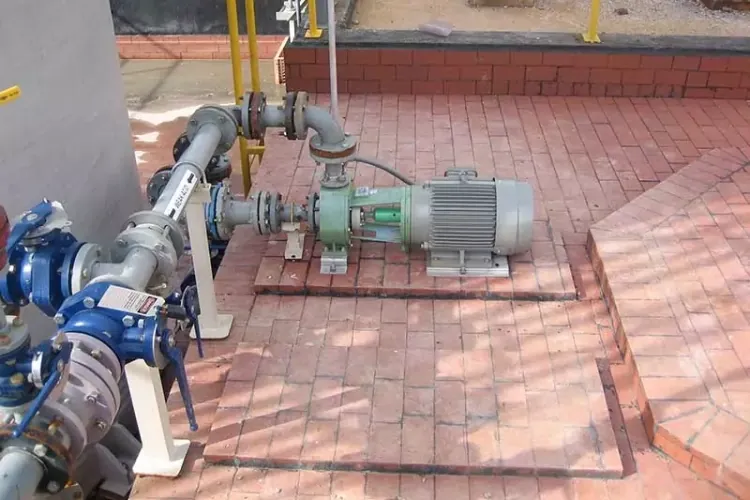
Pumps for sulphuric acid transfer
Sulphuric acid (H₂SO₄) is the most-manufactured chemical in the world, with global output above 250 million tonnes per year. It is present in the fertiliser industry, chemicals, mining, metallurgy, battery manufacture and water treatment. But it is also one of the most aggressive acids for conventional pumping systems: its behaviour changes radically with concentration, it corrodes most metals and it releases heat when diluted.
- Why sulphuric acid (H₂SO₄) demands purpose-built pumps and why a standard steel or cast-iron pump will not do.
- How H₂SO₄ behaves according to concentration: dilute, medium, concentrated and oleum.
- Compatible thermoplastic materials: PVDF, PP, PVC, PE, E-CTFE and PTFE.
- Recommended Tecnium pump series (BN, BKM, BT, BH) based on flow rate, temperature, concentration and ATEX zoning.
- Selection criteria, maintenance and sector experience (fertilisers, chemicals, mining, batteries, water treatment).
Sulphuric acid (H₂SO₄) is the most-manufactured chemical in the world, with global output above 250 million tonnes per year. It is present in the fertiliser industry, chemicals, mining, metallurgy, battery manufacture and water treatment. But it is also one of the most aggressive acids for conventional pumping systems: its behaviour changes radically with concentration, it corrodes most metals and it releases heat when diluted.
Choosing the right pump for H₂SO₄ transfer is not just an efficiency question: it is a decision that affects personnel safety, operational continuity and maintenance costs directly. An error in material selection can lead to leaks, unplanned shutdowns and regulatory penalties.
Tecnium, Spanish manufacturer of corrosion-resistant plastic pumps since 1957, designs and manufactures horizontal, vertical and magnetic-drive centrifugal pumps in high chemical-resistance thermoplastics — PVDF, PP, PVC, PE, E-CTFE and PTFE — capable of handling sulphuric acid across the full range of commercial concentrations and at temperatures up to 120 °C. In this guide we analyse why H₂SO₄ demands purpose-built equipment, which materials to choose based on concentration, and which pump series best fit each industrial application.
Why sulphuric acid demands purpose-built pumps
H₂SO₄ properties and behaviour by concentration
Sulphuric acid is a strong diprotic acid whose chemical properties change dramatically with concentration and temperature. A pumping system designed for dilute H₂SO₄ may fail catastrophically if applied to concentrated H₂SO₄, and vice versa. The four operating ranges are:
- Dilute H₂SO₄ (0-40 %): highly corrosive to almost every metal and alloy. It attacks carbon steels, stainless steels and even special alloys. This is the typical range for water treatment, pH regulation and electrolytic baths.
- Medium H₂SO₄ (40-70 %): the zone of maximum aggressiveness for many materials. It combines the conductivity of dilute H₂SO₄ with high density and viscosity. Particularly critical for elastomers and standard commercial polymers.
- Concentrated H₂SO₄ (70-98 %): passivates carbon steel at ambient temperature (forming a protective layer), but rapidly destroys stainless steels and commercial thermoplastics above 40-60 °C. This is the standard commercial grade (96-98 %) for fertiliser and fine chemical production.
- Oleum (>100 %): H₂SO₄ with dissolved free SO₃. Extremely aggressive, strongly exothermic on contact with water and highly toxic. Requires dedicated materials such as PTFE, exotic alloys or specific steels.
Industrial applications handling sulphuric acid
H₂SO₄ is the most versatile acid in the chemical industry. It is used in hundreds of processes with widely different service conditions in terms of concentration, temperature, flow rate and solid content. The main sectors requiring H₂SO₄ pumps are:
- Fertiliser industry: the largest global consumer (~60 % of total output). Production of superphosphates, monoammonium phosphate (MAP), diammonium phosphate (DAP) and ammonium sulphate. Typical concentrations of 96-98 %.
- Chemical and pharmaceutical industry: organic synthesis, sulphonation, dehydration, catalysis, neutralisation of bases. Concentrations vary according to the reaction.
- Mining and metallurgy: copper and nickel leaching, steel pickling, hydrometallurgical processes. Handling of both concentrated acid and diluted liquors carrying suspended solids.
- Battery industry: manufacture, filling and recycling of lead-acid batteries. Concentrations from 33-38 % (electrolyte) to 96 % (process acid).
- Petroleum refining: H₂SO₄ alkylation for the production of high-octane petrol. Continuous handling of very large volumes.
- Water treatment: pH regulation, ion-exchange resin regeneration, chemical dosing in potable-water and wastewater plants. Typical concentrations of 30-50 %.
Consequences of using an unsuitable pump for H₂SO₄
Installing a pump that has not been designed for sulphuric acid — nor for the specific concentration and temperature of the application — has consequences well beyond a simple mechanical failure. The three most common problem chains are:
Toxic product leaks and chemical burns: progressive corrosion of the pump body, impeller or mechanical seal produces H₂SO₄ leaks. On skin contact it causes severe burns; on contact with water it releases heat and splashes, compounding the risk. Any leak can result in penalties under UK COMAH regulations, DSEAR and equivalent EU Seveso III and ATEX rules.
Unplanned process downtime: in a fertiliser plant or a mining leaching circuit, an unplanned shutdown can mean losses of thousands of euros per hour. The H₂SO₄ pump is a critical piece of equipment; if it fails, entire production lines stop.
Runaway total cost of ownership (TCO): replacing mechanical seals every few weeks, repairing corroded pump casings or replacing full units every year multiplies operating expenditure. A pump correctly specified in PVDF or E-CTFE can operate for years with minimal maintenance.
How to choose the right pump for sulphuric acid
Thermoplastic materials compatible with H₂SO₄
The key to a pump surviving sulphuric acid lies in the materials of the casing, impeller, shaft and seals. Tecnium machines its components from solid-block plastic (not linings or moulded parts), which guarantees that the entire thickness of every component offers the same chemical resistance. The following table summarises compatibility by material and concentration:
| Material | Dilute H₂SO₄ (≤40 %) | Medium H₂SO₄ (40-70 %) | Concentrated H₂SO₄ (>70 %) |
|---|---|---|---|
| PVDF | Excellent up to 100 °C | Excellent up to 100 °C | Good up to 60 °C (concentrations up to 90 %; not recommended above) |
| PP | Excellent up to 60 °C | Good up to 40 °C | Limited |
| PVC | Excellent up to 40 °C | Good up to 40 °C | Limited (low temperature) |
| PE | Excellent up to 60 °C | Good up to 40 °C | Not recommended |
| E-CTFE | Excellent up to 100 °C | Excellent up to 100 °C | Good up to 80 °C |
| PTFE | Universal | Universal | Excellent (including oleum) |
As a rule of thumb: for most applications with H₂SO₄ up to 93 %, PVDF is the reference material thanks to its excellent combination of chemical, mechanical and thermal resistance. For high-temperature applications or oleum, E-CTFE and PTFE are the most robust technical options. For dilute service at ambient temperature, PP or PVC deliver equally reliable performance at a lower cost.
Tecnium pump series for sulphuric acid
The Tecnium range of corrosion-resistant plastic pumps includes specific series adapted to H₂SO₄ handling across the full concentration range and applications:
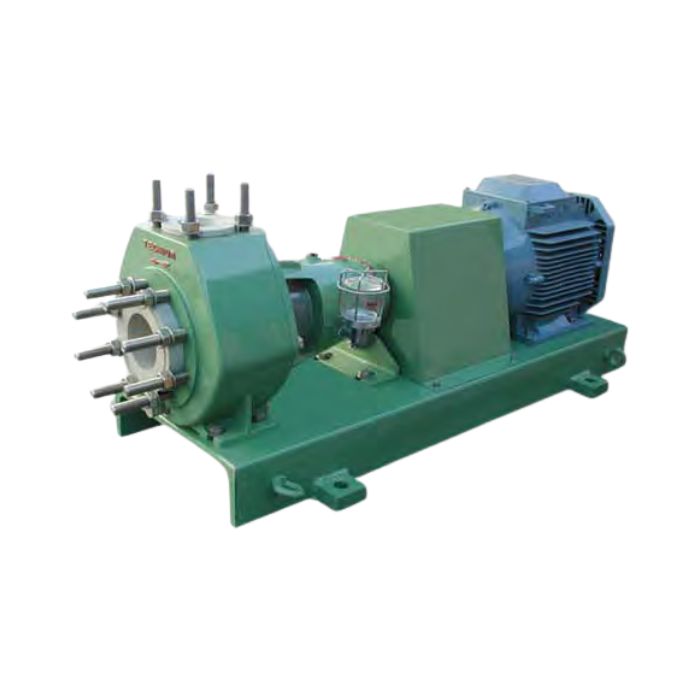
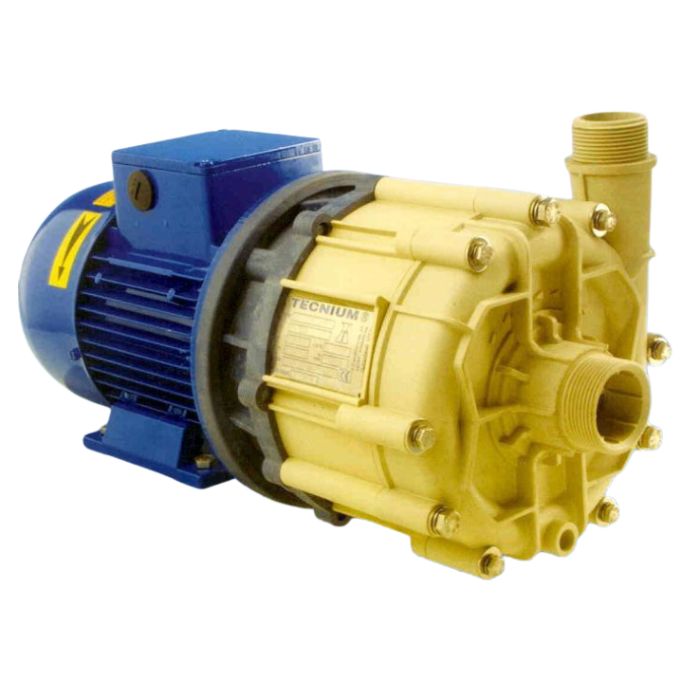
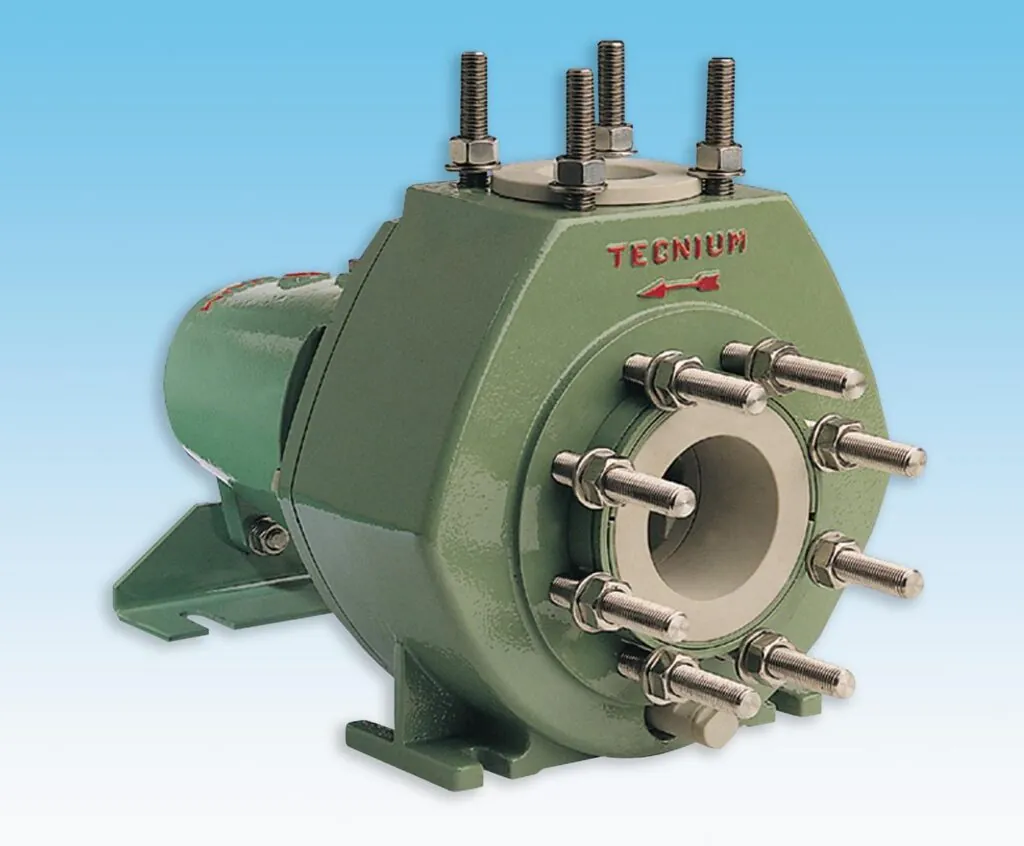
- BN series (ISO 2858): horizontal process pump, ISO 2858 / EN 22858 standardised. Flows up to 1,500 m³/h and heads up to 120 m. Materials: PP, PVDF, PVC, PE, E-CTFE. The reference for transfer and process duty in fertiliser and chemical plants.
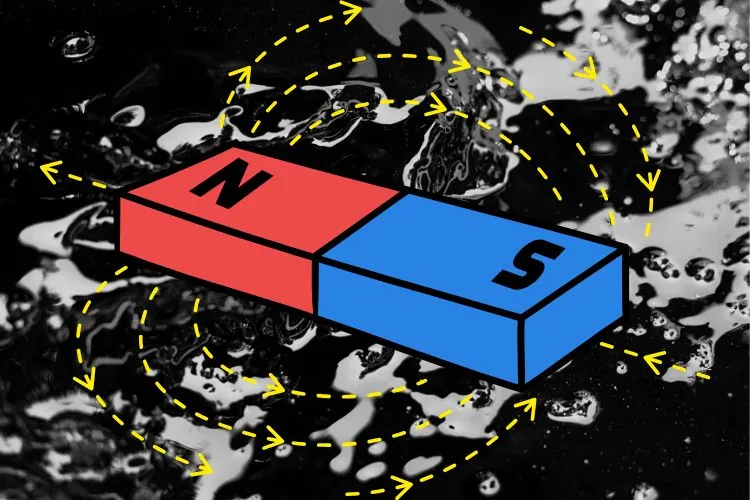
- BKM magnetic-drive series: absolute leak-tightness, no mechanical seal. Particularly suited to concentrated H₂SO₄, oleum or ATEX zones where any leak is unacceptable. Torque is transmitted through a magnetic coupling.
- BT vertical submerged series: no bearing submerged in the liquid, ideal for suction from retention pits or storage tanks. Very well suited to H₂SO₄ containing suspended solids (pickling effluent, mining leachate).
- BV vertical external series: pumping from storage tanks with hydrodynamic sealing. Flows up to 1,200 m³/h. Robust solution for large reagent farms in fertiliser or refinery operations.
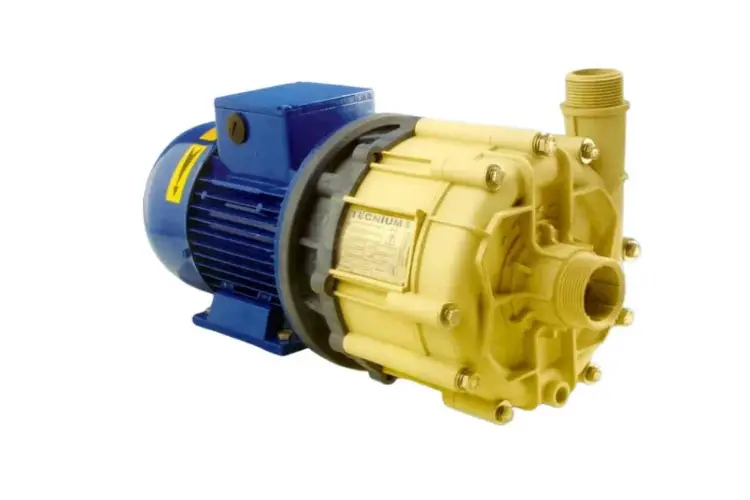
- BH / BX compact motor pumps: for dosing, transfer in mid-size plants or installations with limited space. Flows up to 250 m³/h.
Key selection criteria: flow rate, temperature, concentration and solids
Sizing an H₂SO₄ pump correctly means assessing several process parameters together. The criteria Tecnium recommends reviewing before specifying the equipment are:
- H₂SO₄ concentration: determines casing, impeller and seal material. For 96-98 % (commercial concentrated grade in fertilisers), PVDF or E-CTFE is recommended; for 30-50 % (water treatment), PP or PVC is sufficient.
- Operating temperature: as important a factor as concentration. A given material can move from excellent to unsuitable with just a 20 °C increase in temperature, especially in the 40-70 % range.
- Flow rate and total head: define the pump size. Tecnium’s curves cover from 1 m³/h (dosing) up to 1,500 m³/h (process). Operating close to the BEP prolongs service life.
- Solid content: if the H₂SO₄ carries particles (pickling effluent, mining liquors), the BT vertical series without a submerged bearing is the preferred option.
- Sealing requirements: for concentrated H₂SO₄, oleum or ATEX zones, the BKM magnetic-drive series eliminates the mechanical seal and guarantees zero fugitive emissions.
- Mechanical seal type: Tecnium offers four configurations (SF, DE, IP, IF) with silicon-carbide faces and PTFE bellows, chosen according to pressure, solid content and the need for external flushing.
Maintenance, safety and frequently asked questions about H₂SO₄ pumps
Preventive maintenance and service life of plastic pumps
One of the strong points of the Tecnium design is that maintenance is minimal, even under the most severe service conditions. The pump is disassembled by back-pull-out without moving the piping or the motor, drastically reducing intervention time on site. The key guidelines to maximise service life are:
- Regular inspection of the mechanical seal: it is the component subject to the greatest wear, especially with concentrated H₂SO₄ at high temperature. Check visually for any signs of leakage or dripping.
- Process temperature control: operating above the material’s maximum temperature accelerates plastic ageing. Installing temperature sensors on the suction line provides an early warning.
- Check alignment and coupling: especially on BN pumps with baseplate and flexible coupling, after installation and after every major intervention.
- Critical spares stock: a complete mechanical seal and a set of gaskets avoids prolonged shutdowns. Tecnium keeps permanent stock to guarantee minimum response times.
With these basic practices and correct initial specification, a Tecnium pump handling H₂SO₄ can exceed 10 years of service life, compared with the typical 6-18 months of conventional metallic equipment.
Safety, regulations and best practice
Industrial handling of sulphuric acid is regulated in the UK by COMAH (Control of Major Accident Hazards) and DSEAR (Dangerous Substances and Explosive Atmospheres Regulations), and at EU level by Seveso III, the Industrial Emissions Directive and ATEX 2014/34/EU. Requirements include retention bunds, venting systems, specific PPE, safety distances, personnel training and emergency response plans. Pumps and their ancillary systems must also comply with ATEX where they operate in classified zones.
Best practice in design and installation includes: locating the pump inside a retention bund sized to regulations, providing accessible safety showers and eyewash stations, clearly labelling the fluid, arranging local vapour extraction in ventilated areas, and documenting the construction materials of every component in the site’s technical dossier.
Frequently asked questions about sulphuric acid pumps
For most industrial applications with H₂SO₄ up to 93 %, PVDF is the reference material thanks to its excellent chemical resistance up to 100 °C, high mechanical strength and long service life. For concentrated H₂SO₄ at temperatures above 60 °C or for oleum, E-CTFE or PTFE are the most robust options. For dilute service at ambient temperature (water treatment), PP or PVC offer a reliable and more economical alternative.
Only within very specific ranges and with caution. 316 stainless steel withstands dilute H₂SO₄ at low temperature (below 20 %, up to 25 °C) and concentrated H₂SO₄ (>93 %) at ambient temperature through passivation. Outside these ranges — and especially in the 40-70 % zone — attack is severe. Technical plastic pumps (PVDF, PP, E-CTFE) are the only reliable long-term solution for the vast majority of industrial applications.
The BKM magnetic-drive series is the safest option for ATEX-classified zones: by removing the mechanical seal entirely, it guarantees absolute leak-tightness and zero fugitive emissions. Torque is transmitted through a magnetic coupling. Tecnium offers versions certified in accordance with Directive 2014/34/EU for equipment installed in classified areas (categories 2 and 3).
The basic rule is that acid is always added to water, never the other way round: the reaction is strongly exothermic and adding water to concentrated acid can result in violent splashing. Personnel must wear specific PPE (panoramic goggles, neoprene or butyl gloves, acid-resistant apron, face shield), and the installation must feature safety showers and eyewash stations within 10 metres of the work area, retention bunds sized to regulations and local vapour extraction.
With correct material selection and adequate preventive maintenance, a Tecnium pump in PVDF or E-CTFE can operate with H₂SO₄ for more than 10 years without needing to replace the pump body. Wear components (mechanical seal, gaskets) are replaced periodically according to service conditions, but the Tecnium design allows their replacement without dismantling the pipework, minimising downtime.
The BN series, ISO 2858 standardised process pump, reaches flows up to 1,500 m³/h and heads up to 120 metres of liquid column. For lower flow applications, BH motor pumps cover up to 250 m³/h and BKM magnetic-drive pumps reach 50 m³/h. Selection curves at both 50 Hz and 60 Hz are available in the Tecnium technical documentation to identify the optimal model for each duty point.
If you need a sulphuric acid pump for your plant or facility — fertilisers, chemicals, mining, batteries, water treatment or refining — the Tecnium technical team can help you select the optimal model, material and mechanical seal for your process conditions. Request a no-obligation quotation using the form below and receive personalised advice from a manufacturer with more than 70 years of experience in corrosive fluid pumping.
How can we help you?
Tell us about your application and we will advise you the most optimal solution to solve your needs of gas treatment, odor control and storage and pumping of corrosive fluids.