Stripping: TECNIUM-DEGAS
Groundwater, well water, landfill leachates, manure and ultrafiltered water may contain dissolved gases that need to be removed before subsequent treatment or discharge. TECNIUM has the technology required for this task.
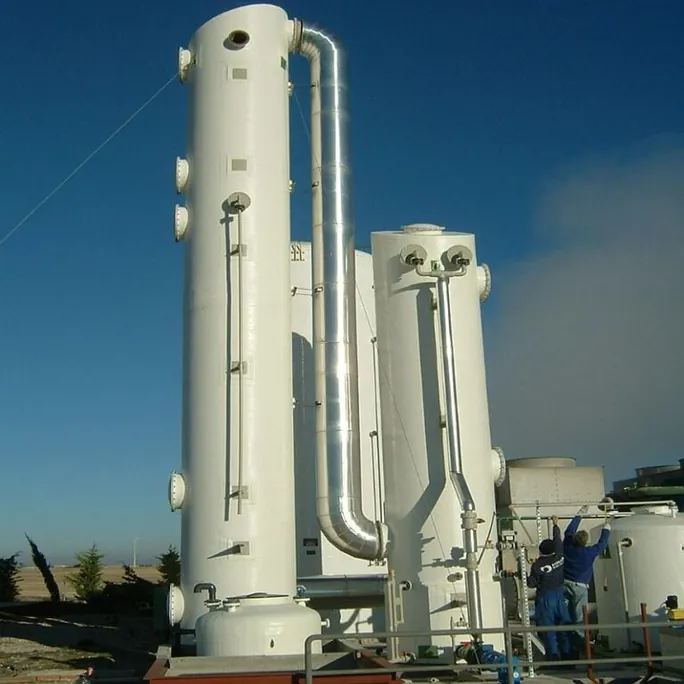
Liquid-gas exchange with high-efficiency contact elements
In many cases, water treatment requires the removal of soluble compounds with high vapour pressure.
TECNIUM PROCESS has developed numerous applications based on liquid-gas exchange, optimised through the use of the most modern contact elements.
Compounds such as NH₃, SO₂, CO₂ and numerous organic derivatives are amenable to stripping. The resulting gas can subsequently be treated in a chemical absorption stage (for example, NH₃ in an acidic medium) for its recovery or destruction.
Key advantages of TECNIUM stripping
A consolidated technology to remove dissolved gases from water before biological treatment, discharge or reuse.
Applications, process and configuration
Applications
- Groundwater and well water
- RSU landfill leachates
- Manure and livestock digestates
- Ultrafiltered water and RO permeates
- CO₂ degassing in reverse osmosis and ion exchange
- Removal of NH₃ and amines before biological treatment
Process
- Pre-adjustment of water pH and temperature
- Distribution at the top of the tower over the packing
- Counter-current liquid-gas exchange with air or steam
- Collection of treated water at the bottom
- Routing of the extracted gas to downstream treatment
Materials and configuration
- Body in PP, FRP, PVC or PVDF
- QUIMIPLEX-type packing with cross-flow diffusivity
- Flow rates from 1 to several hundred m³/h
- Corrosion-resistant plastic fans
- pH, flow and temperature instrumentation
Industrial references for TECNIUM-DEGAS
Three examples of operating installations that illustrate the application range and the performance achieved.
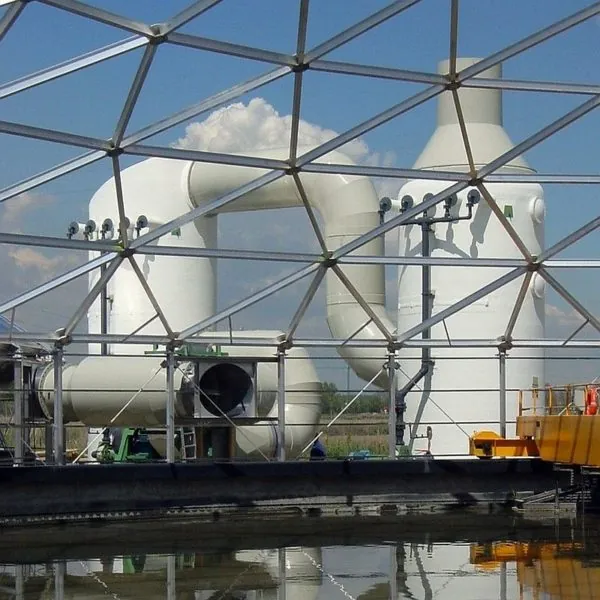
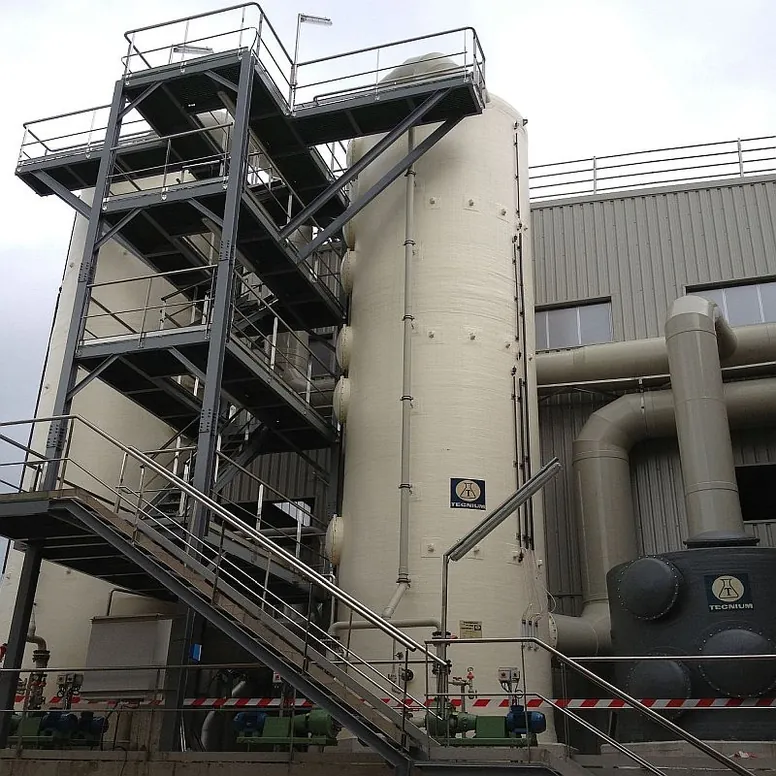
Ammonia nitrogen stripping in landfill leachates
Removal of NH₃ from leachates of a municipal solid waste landfill. The process is completed with acidic absorption of the released ammonia.
Trichloroethylene stripping in degreasing water
Industrial water effluents from metal parts degreasing. QUIMIPLEX-type contact units.
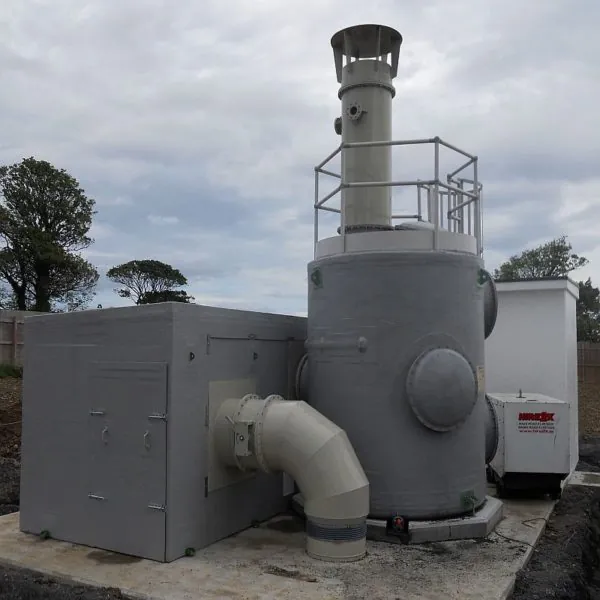
CO₂ degassing after reverse osmosis
Removal of CO₂ from water coming from reverse osmosis and ion exchange plants. Cross-flow diffusivity units for an optimal liquid-to-gas ratio.
FAQs on TECNIUM-DEGAS stripping
The most common queries on water stripping, stripping agent selection and combination with other stages.
What is stripping and when should it be applied?
Stripping is a mass transfer operation that removes volatile compounds dissolved in a liquid stream by bringing it into counter-current contact with a gas (air or steam). It should be applied when water contains dissolved gases (NH₃, CO₂, SO₂, H₂S) or volatile organic compounds (VOCs, mercaptans, chlorinated derivatives) that must be removed before biological treatment, discharge or reuse.
Which compounds does it remove most efficiently?
TECNIUM-DEGAS is particularly effective with soluble compounds of high vapour pressure: ammonia (NH₃), carbon dioxide (CO₂), sulphur dioxide (SO₂), hydrogen sulphide (H₂S), trichloroethylene and other chlorinated solvents, as well as a wide range of VOCs. For compounds with low vapour pressure, alternatives or combined stages are considered.
Does the extracted gas need to be treated?
Yes, except in specific cases where stack dilution is sufficient. The usual approach is to route the extracted gas to a downstream chemical absorption stage (NH₃ in an acidic medium, H₂S in an alkaline medium), to biotrickling or to carbon adsorption. TECNIUM designs the full stripping + extracted-gas treatment line to avoid simply shifting the contaminant from one phase to another.
Which materials are used in the stripping tower?
The tower body is manufactured in PP, FRP, PVC or PVDF depending on the water pH, temperature and contaminants. Internals (distributors, packing support) are in PP or PVDF, and the typical packing is QUIMIPLEX type with cross-flow diffusivity. In cases with high temperature or pressure, stainless steels such as AISI 316 are used.
What influence does pH have on NH₃ stripping?
Critical. Ammonia is in equilibrium NH₃/NH₄⁺ and only the free fraction (NH₃) can be stripped. At pH 11 practically all the nitrogen is as free NH₃ and stripping is efficient; at pH 7 it is as NH₄⁺ and cannot be removed. For this reason the standard design includes a prior pH adjustment with NaOH before the tower, and often a downstream pH reduction step.
What flow rates can the TECNIUM-DEGAS range handle?
The typical range spans from 1 m³/h in small reverse osmosis plants up to several hundred m³/h in large WWTPs and leachate treatment plants. The tower is sized case by case from the flow rate, the inlet concentration, the target concentration, the temperature and the stripping agent (air or steam).
Send us your details and we will advise you
We will help you size the most suitable TECNIUM-DEGAS stripping system for your water, contaminants and target concentration.
- Water characterisation and packing selection
- Integrated design with extracted-gas treatment
- Corrosion-resistant materials selected by TECNIUM
- Start-up and global aftersales support
Request information
Complete the form and our technical team will get in touch with you.
Explore all our solutions
Discover the full range of TECNIUM products for the treatment of corrosive fluids and polluting gases.