Absorption: TECNIUM-CHEM
Under this technology TECNIUM supplies multiple gas scrubbing and odour control systems through absorption with water or chemical reagents, using scrubbing towers, venturi scrubbers and cyclones.
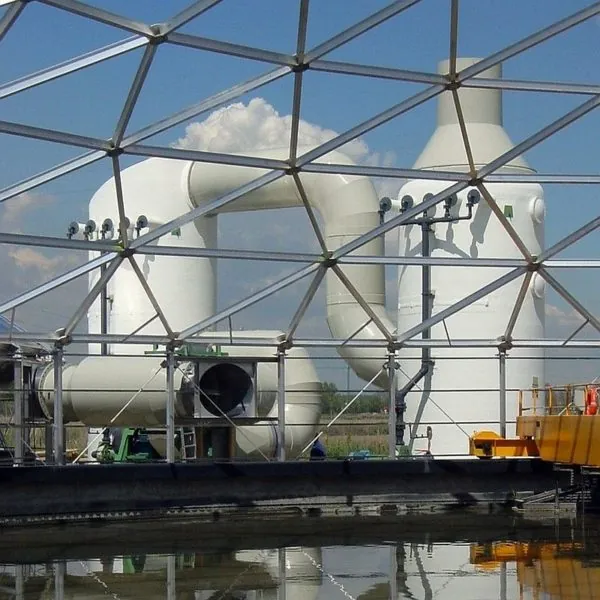
Chemical absorption tailored to the contaminant to be treated
In many cases, contaminants present in gases can be oxidised or absorbed in an alkaline or in an acidic medium.
Nitrogen derivatives (NH₃, R-NH… etc.) are amenable to absorption in an acidic medium, while sulphur derivatives (H₂S, R-SH, R-S-S-R, etc.) are usually absorbed in an alkaline or oxidising medium.
Organic derivatives of carbon (R-COH, R-CO-R and VOCs in general) are in some cases broken down into CO₂ and H₂O through energetic oxidation.
Applications of TECNIUM-CHEM
Tailor-made chemical absorption solutions designed for each contaminant matrix and for the most demanding industrial sectors.
WWTP and composting
- Wastewater treatment plants: pumping wells, thickeners, preliminary treatment and dewatering
- Composting plants and digesters
- Control of H₂S and mercaptans in sewers and pumping stations
Food industry
- Odours from slaughterhouses
- Animal fat processing
- Fish processing plants
- Industrial frying and cooking
Chemical, pharma and incineration
- Gases from reactor venting
- Chemical and pharmaceutical industry
- Incineration and inertisation gases
- Processes with HCl, HF, SO₂, Cl₂ or NOx
Key advantages of chemical absorption
A consolidated technology, scalable to any flow rate and delivering very high efficiencies on specific contaminants.
Technical configuration of the CHEM range
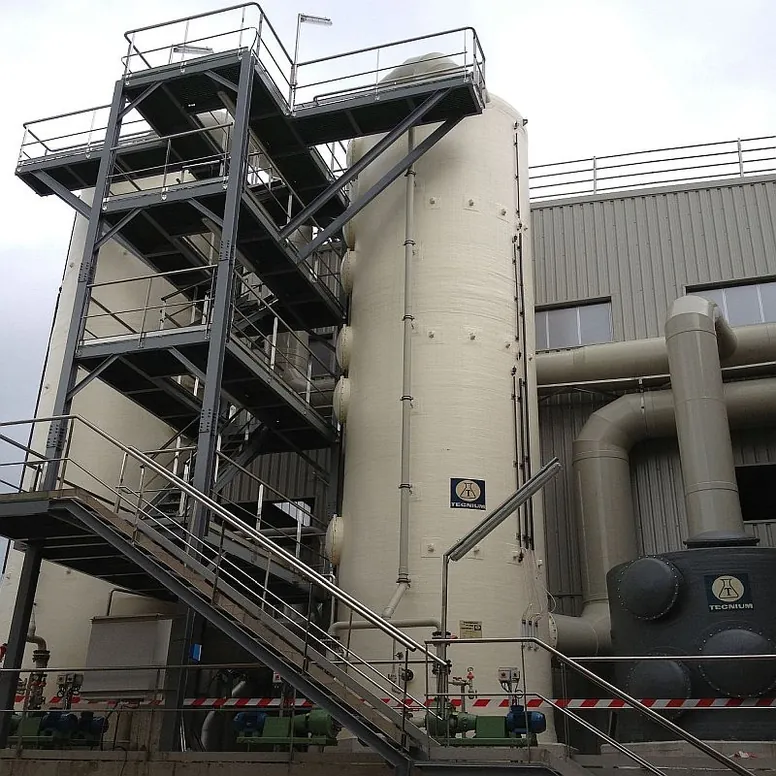
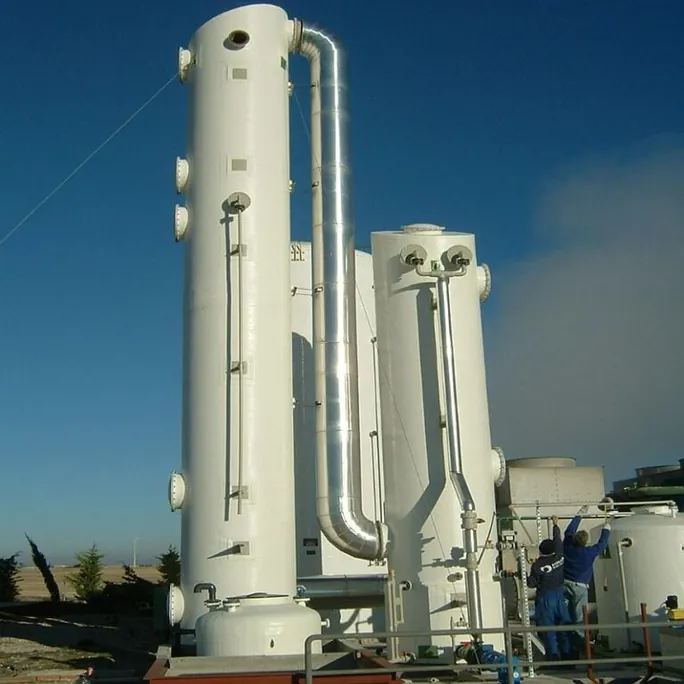
Scrubbing towers
- Vertical with random or structured packing
- Multiple stages for contaminant mixtures
- Flow rates from 100 to 100,000 m³/h
- Body in FRP, PP or HDPE
Venturi scrubbers
- High efficiency in capturing fine particles
- Adjustable throats for varying loads
- Combinable with downstream cyclones
- Suitable for gases with high solids content
Cyclone separators
- Pre-separation of particles and droplets
- Series integration with towers and venturis
- Protection against corrosion from carryover
FAQs on TECNIUM-CHEM absorption
The most common queries on scrubbing towers, reagent selection and differences from the biological route.
When is chemical absorption recommended over biotrickling?
Chemical absorption is the preferred option when contaminants are present at high concentration, when there are highly variable spikes, when compounds are poorly biodegradable, or when emissions must remain below a very strict threshold from the first minute. The biological route shines under stable operation with biodegradable compounds and low concentrations; the chemical route is the choice for H₂S, HCl, HF, SO₂, Cl₂, NH₃ and NOx with variable loads.
Which reagents are used for each contaminant?
For acidic gases (H₂S, HCl, HF, SO₂), caustic soda (NaOH) is used in an alkaline medium, often combined with sodium hypochlorite (NaClO) when mercaptan oxidation is also required. For ammonia and amines, sulphuric or hydrochloric acid is used in an acidic medium. For oxidisable VOCs and organic odours, strong oxidants (NaClO, H₂O₂) are applied under controlled pH and ORP conditions.
Which materials are used to prevent corrosion?
Tower body and piping in FRP (glass fibre reinforced polyester), PP or HDPE depending on temperature and chemistry. Internals in PP/PVDF (nozzles, distributors, packing), gaskets in EPDM or Viton, and instrumentation with titanium or PVDF probes. All materials are selected case by case based on the contaminant matrix and the operating temperature.
How is the system controlled in operation?
Typical control is by pH and ORP: a probe measures the pH of the recirculation liquor and doses reagent to maintain the setpoint; the ORP indicates oxidant availability. Conductivity is also monitored for purges, along with liquor and air flow, temperature and level. The entire assembly is integrated into the customer’s SCADA or PLC, minimising manual intervention.
Can several stages be combined in series?
Yes, and it is the most common solution when there are incompatible contaminant mixtures. For example: a first acidic stage to retain NH₃ followed by an alkaline stage with hypochlorite for H₂S and mercaptans. TECNIUM also combines towers with venturis or cyclones when particles or droplets that could foul the packing are present.
What documentation is supplied with the equipment?
Every TECNIUM-CHEM equipment is delivered with certified drawings (dimensions, connections, anchors), material selection report, installation and start-up manual, operation and maintenance manual, instrumentation data sheet and, where applicable, welding, hydraulic test and ATEX certificates. Assisted start-up and operator training are included in the standard scope.
Send us your details and we will advise you
We will help you select the right TECNIUM-CHEM configuration for your flow rate, contaminant matrix and the emission limits applicable to your plant.
- Feasibility study and reagent selection
- Custom process design
- Turnkey equipment with instrumentation
- Start-up and global aftersales support
Request information
Complete the form and our technical team will get in touch with you.
Explore all our solutions
Discover the full range of TECNIUM products for the treatment of corrosive fluids and polluting gases.